

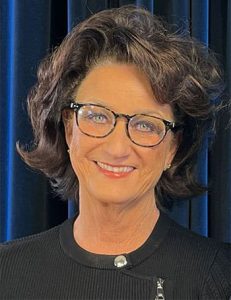
Interview Date: February 20, 2026
Interviewer: Stewart Schley
Series: Women In Cable Archive
Note: 2022 Cable Hall of Fame Honoree
Abstract
Patricia Jo Boyers’ oral history traces her path from underground construction contractor to pioneering rural cable entrepreneur and influential advocate for independent operators. She recounts how, in 1992, after being told cable service would never reach her rural home in southeast Missouri, she and her husband Steve decided to build their own system—an effort that grew from a single “most expensive house drop ever” into Boycom Cablevision, now serving five counties. Boyers vividly describes the grit required to launch and sustain the company: financing expansion through local banks and SBA loans, building infrastructure across difficult terrain, manually billing customers, and continually upgrading from coaxial cable to fiber and broadband services. Her reflections emphasize both the physical labor of the business and the entrepreneurial mindset behind it—improvising, taking risks, and surviving “the next 30 days” while adapting to constant technological change.
A second major theme is Boyers’ emergence as a forceful political voice for small, independent cable operators. She explains how regulatory barriers, retransmission consent, and federal broadband policy pushed her into advocacy, first through personal dealings with lawmakers and later through leadership roles in ACA, where she became only the second woman to serve as chair and its longest-serving chair. Throughout the interview, she argues that rural broadband requires targeted public-private support, especially in high-cost areas where private investment alone will not close the access gap. Interwoven with these policy views is a portrait of Boyers’ leadership style: blunt, resilient, deeply grounded in hands-on experience, and committed to opening more space for women in operational leadership. She is both builder and advocate, and her story reflects the independent spirit, labor intensity, and public-policy stakes of the cable and broadband industry.
Interview Transcript
STEWART SCHLEY: (intro music plays) Greetings, good day, and welcome to this episode of the Hauser Oral History Series presented by Syndeo Institute at the Cable Center. I’m Stewart Schley, and I want to start out by saying there are two types of cable companies in this land: big corporate conglomerates and generally smaller independent operators. Similarly, there are two types of people in this land. There’s Patricia Jo Boyers and everybody else. In the house, Patty Boyers. So happy to have you today.
PATRICIA JO BOYERS: Thank you so much.
SCHLEY: Yeah, there’s a lot to talk about. You are a true entrepreneur in this industry and have been for a long time. Let me just take the Wayback Machine and inject you into a particular year I’m going to choose. It’s 1992. Where are you, what are you doing, and why are you doing it?
BOYERS: In 1992, we were — my husband and I — were finishing up an underground, one of the first fiber-optic underground jobs in Michigan. We had a general contract with Cablevision. There’s a company that nobody talks about anymore; all gone.
SCHLEY: The big Cablevision.
BOYERS: The big Cablevision. And they were putting underground fiber tie in Detroit all the way to Lansing. And we were the contractor on that job in 1992. So we’d been in the underground construction — phone, cable TV, custom rock road-boring — and had done that for 17 years. Nineteen-ninety-two, we decided we wanted to have cable at our house.
SCHLEY: Where’s your house?
BOYERS: Our house is out in the sticks —
SCHLEY: Okay. (laughs)
BOYERS: — in Southeast Missouri, past a strip of national forestry, U.S. National Forestry. And we called — at the time it was Midwest Cable TV — and said, “Hey, what would it take to get cable TV to our house?”
SCHLEY: They were the nearby operator?
BOYERS: They were the operators inside the city of Poplar Bluff. And we were told not only no, but, “Hell no,” because they would have had to go across the Mark Twain National Forest. And so, Steve said, “Well, we’ve been building these systems for other people. Let’s just drive around and count houses that don’t have cable TV.” And that’s what we did. We decided we were going to build cable TV. Most expensive house drop ever when we finally turned the cable TV on at our house.
SCHLEY: This was no modest bet. The economics were tough, right?
BOYERS: Oh, they were tough. But that was back in the cowboy days, you know. It was rough riders. And I learned a term this week, it’s called, “You build the plane as you fly it.” That’s what we were doing. I love that. I’m going to use that for me. I just took that, Susie. I just took it.
SCHLEY: I think you’re allowed dispensation. So you built the system.
BOYERS: We did.
SCHLEY: And what was the breadth or the reach? Or how many homes were involved?
BOYERS: Well, initially, before we borrowed our first dime, we had 427 customers online. We changed where — our office was in the basement of our house. And we had purchased a piece of property that was geographically appropriate for a headend. I erected a tower, built a building, and then printed business cards. And while the ink was still wet, we hauled off to a couple of cable shows just to find out what the hell the business was all about.
SCHLEY: What was the business all about? How many channels are we talking, and what were your —
BOYERS: I think we probably launched — it was in the 23- to 25-channel. And it’s singular. It was cable TV only. And it was all coax system. About, I would say, 75 to 80 percent all-aerial. Because we’re in the foothills of the Ozark Mountains, and there’s a lot of rock, a lot of — it’s Southeast Missouri.
SCHLEY: It’s hard terrain.
BOYERS: Very hard terrain. And so, we did do some underground, because we’re underground contractors.
SCHLEY: That’s what you did.
BOYERS: Very irregular to come from the construction side of the house to the operations side of the house and to be a first-generation — ultimately — MSO.
SCHLEY: But had you not been in the contract construction business, you wouldn’t have done this. I mean —
BOYERS: No.
SCHLEY: — it set you up.
BOYERS: We wouldn’t have thought we could.
SCHLEY: Yeah.
BOYERS: You know.
SCHLEY: Yeah.
BOYERS: We probably still shouldn’t have, looking back, we probably shouldn’t have. But we didn’t know any better.
SCHLEY: I’m so intrigued that you wanted your MTV. You wanted cable TV.
BOYERS: Actually not the MTV, but, you know, it gave me the old CMT. Country Music Television —
SCHLEY: Country Music Television, yeah.
BOYERS: — was right down our alley. But no, honestly, we really wanted it at our house.
SCHLEY: And then talk about today. Could you describe your operation today?
BOYERS: Oh, our operation today is in five counties, all in Southeast Missouri. Our flagship system is in Poplar Bluff, Missouri. And we are in four other surrounding counties that we provide service. We have five total systems. All but one are tied together with a redundant fiber ring. And we are 74 percent still DOCSIS 3, DOCSIS 2, and HFC. And the balance is fiber-to-the-home.
SCHLEY: In ’92, Patty, there are a couple of things that were interesting environmentally. But one was, there was a lot of fervor over the chance that the cable industry could start to deliver telephone service.
BOYERS: Oh, I’ll tell you what, it was nothing but dadgum doom and gloom. We became members of the NCTC. The National Cable Television Cooperative, at the time, is what they called themselves. And we went to the first meeting — we were out in Tahoe — a very small meeting. And whenever you went to that meeting and you sat there with those guys, they were all the owners. They were all the builders of their systems. It’s not anything like it is today, when you go to a cable show, and you’re sitting with the CEO, or you’re sitting with a COO, the C-suite folks. The people who own it are private equity or they’re capital investors.
SCHLEY: You were dealing with the real —
BOYERS: The real guys.
SCHLEY: — guys, yeah.
BOYERS: And so, when you look at that sheet, and it says “X, Y, and Z,” how many subscribers, they own that system, you know? So that was the bootleg days. I like to refer to it as the “cowboy years” of the industry.
SCHLEY: That’s honestly one reason it’s fun to talk to you. This was emblematic of the pioneering spirit of this industry.
BOYERS: Oh, absolutely. And that was also tongue-in-groove with my getting involved politically, which is really my wheelhouse. That’s one of my — I have an affinity and a love for the political process and advocacy on behalf of little old bitty folks like Steve and I. Because that Mark Twain National Forest I spoke of? You had to have a permit. And 18 months later, we still had no permit to cross an existing easement, given to REA, to attach to their poles. But we still had to do an environmental, because you might run over a caterpillar? I don’t know. It was stupid.
SCHLEY: Was this a federal government —
BOYERS: Oh, the federal freaking government, U.S. Forestry. And it was a nightmare. And so, Steve and I were invited to go to meet our congressman at the time. Bill Emerson was our 8th Congressional District for the State of Missouri. And Jason Smith sits in that seat today. And so we got to actually sit down with Bill. And he said, “Well, this is stupid.” And I said, “Well, I’m glad we agree on this. But what can we do about it?” He said, “Let me make a few phone calls.” And by the time our congressman was finished with U.S. Forestry, they were hand-delivering the permit to us — signed, sealed, and delivered — and we were able to begin construction. And that’s what fed it to my house.
SCHLEY: Yeah. You were up close and personal, understanding, “This could actually work.” You have legislative influence.
BOYERS: Evidently, I found out that it’s not who you know, it’s who knows you. So if you have a good, solid, sound, sturdy voice, and you’re telling your story, nobody can argue with your story. Because it’s my story.
SCHLEY: Because it’s your story. Right.
BOYERS: And we built it ourselves. And I know what it takes to do everything. So I can refute whatever you’re telling me.
SCHLEY: Because you’ve seen it, been there, done that, got the T-shirt.
BOYERS: Absolutely. We were the “man in the arena.”
SCHLEY: The economics had to tough early on. You’re trying to generate cash flow over time, and you’ve got all these expenses — and borrowed funds, I presume, to start the company?
BOYERS: We did eventually. But we had our first 400-and-some-odd subscribers turned on before we wanted to build some more. And then we went to local banks. We’ve always utilized rural banks. And SBA, because we weren’t big enough to command the attention of anybody that wanted to invest in us.
SCHLEY: You mentioned the purchasing cooperative NCTC. Why were they vital to what you did?
BOYERS: Oh, gosh, they were vital to anybody our size, smaller, even the bigger guys at the time. They were a collective bargaining cooperative that was formed up, literally, by about eight or ten people in a hotel in Kansas City. And they said, “You know, the big guys can buy all this programming for cents on the dollar. And they’re charging us dollars on the dollar. And we believe that if we band together that we can command the same price as the big guys.” That equity has never been reached. However, at a significant enough discount has been, and the NCTC is still thriving today on that same model.
SCHLEY: Would have been tough to have to pay, as you said, dollar on the dollar as an independent operator.
BOYERS: Couldn’t have done it. If it had not been for the co-op, we would have never been able to have launched our system.
SCHLEY: The other reason I think ’92 was significant, there was a very onerous piece of federal legislation passed by the Congress, enough votes to override a presidential veto. What did that law do to the industry? What was its effect?
BOYERS: Ignorance is bliss, let me tell you. Because at the time, we didn’t know about it. At the time, we didn’t know about the ’92 Cable Act.
SCHLEY: You’re busy burrowing through rocks —
BOYERS: Well, yeah, I mean —
SCHLEY: — and building fiber lines, yeah.
BOYERS: — we actually incorporated Boycom Cablevision in December of 1992. We would’ve been in construction in January of 1993. And simultaneously we’re building a building. And we’re launching. And we are building and launching and building and launching. You know you build it, you turn it on, and you push it on out. You turn it on; you push it on out. And the interesting thing was, Frank Hughes with the NCTC said, “Hey, you kids need to come out to Squaw Valley and come to the first meeting.” So we get out there. Oh my God, everyone was in burial shroud. It was like doom and gloom; the sky was falling. Henny Penny was on the agenda. Everybody was scared that the coax cable, the vehicle that produces cable TV at the time, would fall to the wayside, and copper would become king, and the phone companies would take over.
SCHLEY: Okay. And the regulation was, again, onerous on the rate side, right? It was a rate-restricted —
BOYERS: Absolutely rate restricted.
SCHLEY: — piece of legislature.
BOYERS: And that was what birthed ACA, which is an advocacy group for small, independent cable TV owners.
SCHLEY: Separate from NCTC, the purchasing cooperative?
BOYERS: Separate from NC– we share a lot of the same members — but separate.
SCHLEY: Okay. Did you feel that the small operators had a voice in Washington, DC, at all?
BOYERS: They did not. They did not. And had it not been for that little old bitty organization, formed up specifically to combat retransmission consent and must-carry, the rate regulation thing got thrown out. If you read on down the line, it got thrown out in the ’96 Cable Act. And so, it was — Sure. I’m really good friends with some of the big guys, the three Cs. But we are not the same.
SCHLEY: The “three Cs” being?
BOYERS: Charter, Comcast, Cox. We are not the same. A small operator is not the same. We have many, many, many more hurdles simply because of scale.
SCHLEY: Right.
BOYERS: And if I only have 25 homes per mile passed, and they’ve got 400, and it costs me the same amount of money to lay that mile of cable, then you can see where the ARPU lies. But was it a challenge? Yes, it was a challenge. Could we do it? We did.
SCHLEY: Yeah.
BOYERS: Yeah. I mean, we’ve put a lot of shoes on a lot of people’s kids over the last 35 years.
SCHLEY: Two definitions for the uninitiated, you mentioned ARPU. It’s an acronym that basically speaks to revenue per month from a particular customer.
BOYERS: Absolutely. From a unit.
SCHLEY: Why is that such an important metric for this business?
BOYERS: Well, because that’s how you sell it if you want to sell it. And that’s how you know whether or not what your investment is. You do the investment the same way. And so, the difference between that is your profit or your loss.
SCHLEY: When you started, what was a monthly cable bill? I mean, what did people pay for services?
BOYERS: (laughs) $12.99.
SCHLEY: You remember! $12.99. And how did you do the billing?
BOYERS: And we did it all manually. We did our dead-level best to try to emulate our Rural Electric Association. Same size envelope. Same size return envelope. And so, we billed out the same time Ozark Border billed out, so that people were familiar with paying their light bill, water bill, cable bill. “Come on down. We have a front desk.” People could come in on the tenth of the month. It was Old Home Day. Back in those days, you knew all your customers. I mean, you see them in the grocery store. They’re sitting in your Sunday school class at church. And back in those days, we were not such a necessity. We were a luxury.
SCHLEY: That’s, Patty, what I was going to ask. Was the demand pretty pent-up, though? People really did want this service, right?
BOYERS: Oh, absolutely. Because I’m here to tell you, all we could get was three channels. Two of them pretty well, one of them, no. And it was like, my dad would say, “Patty Jo, go out there and turn the antenna!” And you turn the antenna if you wanted to watch NBC. If you wanted to watch CBS on Monday nights at 8:00 when Gunsmoke came on, we had to go turn it back. And if the president was on, hell, you were snakebit. Because all you could see was the president’s face on all three channels that you had.
SCHLEY: I’m glad you brought it up, because this was my other definitional advisement that you can share with our audience, “retransmission consent” and the relationship between over-the-air television and cable. What are we talking about, and how has it evolved over the years and affected your business?
BOYERS: Well, retransmission consent is the elephant in the room. Because it was part of the ’92 Act. And it provided a pathway for all broadcast free TV to be able to have more eyeballs. So if you have a closed system, I’m just a passive re-transmitter of somebody else’s signal. So the more that I can put on, the better off we are, and the more the customers have to watch. Because we all know, even today, the idea of content is still alive and well. Everybody thought it was going to die. It’s still alive and well.
SCHLEY: More so than ever.
BOYERS: You’re seeing a resurgence of, God forbid, the word “bundle,” because people have all this app fatigue. But they’re still wanting the content. They still want to watch original programming. They still want to watch the news. They still want to watch real live sports. And so, it’s part of our culture. And it was just beginning. So there was a voracious appetite in those days to build.
SCHLEY: But these, as you said, originally were free-to-view television stations. You put up an antenna. You didn’t pay a dime to watch your old NBC or CBS — or your Gunsmoke affiliate.
BOYERS: You could still do that today. You have to have a digital antenna, but you could still do that today. Which is one of my points of massive contention with the law.
SCHLEY: We’ll get to it. But my point is, with retrains, that was codified in this ’92 Act, now these free over-the-air stations could come to Patty and say, “Hey, if you want to put our signal on your cable system, pay them in.”
BOYERS: No, actually not originally.
SCHLEY: What was originally?
BOYERS: Everybody elected must-carry, because they were afraid they weren’t going to get the opportunity if we had a finite amount of spectrum, if they wanted to get on your system to get all the eyeballs that didn’t have an antenna anymore. They’re going to say, “Hey, will you please, please put me on your system? We’ll sign must-carry. You don’t have to pay us a dime. Just put me on.” And if I’m Channel 12, CBS out of Cape Girardeau, Missouri, can you put me on the channel 12 slot? Okay, and when people turn on and punch that 1 and the 2, well, they get channel 12. Sure, we’ll do that.
SCHLEY: So, must-carry involved no obligation to pay those stations on your part.
BOYERS: No, not at all. To elect must-carry, that meant I had to carry them, because I agreed to do it contractually.
SCHLEY: Okay. But it did change over time.
BOYERS: Oh, hell, yeah, it changed over time. They saw a cash cow.
SCHLEY: Yeah.
BOYERS: They saw the hand of the government on the scale in the favor of the broadcasters as a revenue stream. And today, it is their greatest revenue stream.
SCHLEY: Cable companies pay a lot of money to free television stations.
BOYERS: Yes, we do.
SCHLEY: What did that do to the P&L and the balance sheet and the fundamental financials of running your system?
BOYERS: Initially you try to absorb it. But you can’t do that forever. I mean, at the end of the day, you simply cannot provide a service below cost and make it up on volume. It doesn’t work that way. The only people that worked with is the federal government. So, you know, it’s a pass-through for us. And it’s a line item on my bill: “Here’s your NBC. Here’s your ABC. Here’s your FOX. Here’s your CBS. And that’s what it’s costing you.”
SCHLEY: Yup. And besides the financial pressures, how did you guys maintain currency technologically over the years? Continual investment in the property?
BOYERS: Hook. Or. Crook. Absolutely. Now, I will tell you right now, my husband —
SCHLEY: Steve.
BOYERS: — Steve —
SCHLEY: We’ve mentioned Steve a couple times.
BOYERS: — is a huge entrepreneur. He’s the one that comes up with the ideas. I’ve always said he’s a big old boy, but he can stand on my shoulders with his head in the cloud and come up with all these ideas. And my feet are on the ground trying to put feet to them.
SCHLEY: In real-world, day-to-day —
BOYERS: In real-world.
SCHLEY: Yeah.
BOYERS: And he will tell you, the ideas that he comes up with that don’t work or didn’t work or wouldn’t work that we left alone — like, he wanted to be in the racetrack business.
SCHLEY: Why not?
BOYERS: Really? And so I talked him out of that one.
SCHLEY: Okay.
BOYERS: We’re not Branson, Missouri. We don’t need to have a go-kart track. But lots of opportunities. We were in the mobile-home business. We were the fourth-largest dealer of pre-manufactured housing in the state of Missouri for ten years. Sold pre-manufactured housing.
SCHLEY: At the same time you were in the cable business?
BOYERS: Oh, yeah. Oh, absolutely, yeah.
SCHLEY: Oh my gosh.
BOYERS: And we’ve always had a cattle farm.
SCHLEY: You described that as a “hobby” one time. Seems like a very expensive hobby. (laughs)
BOYERS: Well, it is. It’s an expensive hobby. Finally cattle prices are pretty all right right now.
SCHLEY: You said something that really captivated me in a recent interview. You said your goal was always to survive the next 30 days.
BOYERS: Yeah, that’s me. Now, Steve —
SCHLEY: Right.
BOYERS: Steve’ll be the one that —
SCHLEY: “Don’t worry about it.” Yeah.
BOYERS: — walks in there. Back in the construction days, you had what you call “bid season.” January, February, March. Everybody comes up with what they’re going to do that year. They’ve set their budgets in October. And so they start putting out contracts first of the year, first quarter of the year. And then you’re set for the year for the work you’re going to do. And so, March 31 rolls around, and you don’t have a job. You’ve bid, bid, bid. And I would say, “Steve, what are we gonna do?” Oh, he didn’t care. He said, “You’ll figure out something.” He said, “The best job we’re ever gonna have this year we don’t even know about yet.” And off to the barn he would go. He never, ever worried about how those 12 months of payments were ever going to get made. And I got to tell you, that was in the ’80s, when interest was much like it was right now.
SCHLEY: It comes around. Right.
BOYERS: Eighteen, twenty-two percent. If you had a mortgage ten and twelve percent, you were stellar credit.
SCHLEY: You were in the pink, right.
BOYERS: You were absolutely amazing. And so, nothing legal works at those interest rates in the ’80s. God bless Jimmy Carter. So it was a struggle. But honestly, I think we were just too stupid, too strong, and too hell-bent to make it work.
SCHLEY: Too stubborn to not make this —
BOYERS: Absolutely.
SCHLEY: But in this business, you do have to continue to pour money into these systems, right?
BOYERS: Oh, absolutely.
SCHLEY: Like, for what? Like for example, what are you investing your capital in? Fiber? Different means of transmission?
BOYERS: Oh, it’s fiber. It’s pushing it out. It’s $150,000 for a bucket truck today.
SCHLEY: Not for the faint of heart.
BOYERS: No, it is not. And initially, when we started in, we just had little work trucks and little boys with climbers climb the pole. Not ladders. Climbers.
SCHLEY: But you’ve seen the television side of this business change so dramatically since you started delivering — you said 25 one-way channels.
BOYERS: Absolutely.
SCHLEY: But you’ve been able to keep up with it. And you guys at Boycom, your company, recently introduced some interesting alternative ways to get video delivered over the pipe.
BOYERS: Yes, we will. That launch will take place officially, to the customer, April 1.
SCHLEY: What is happening?
BOYERS: We’re doing IPTV over the top. It’ll be something that gets us off the C-band. Because the FCC is requiring us to get off the C-band completely. And this is an alternative way of getting off the C-band. Our customers will also be able to have a box, and they can figure out what they want. Or we can go use a Fire Stick or anything like that. And the linear television product, as it has been known for our company all these years, will go away.
SCHLEY: Who woulda thunk, right?
BOYERS: Well, yeah. The technology, it’s hard to keep up with all of the technology.
SCHLEY: We were talking about the fervor over telephone back in the early to mid-1990s. And it turns out, yes, this industry played a big role in transforming residential voice service. Did you guys introduce a telephone, a voice product?
BOYERS: Oh, absolutely. We have a voice product today. It constitutes about 13 percent of our revenue.
SCHLEY: Okay. What about the other big contributor, broadband high-speed internet?
BOYERS: Ah, that’s going to be 74 percent of our revenue.
SCHLEY: Did that sort of blow you away that the demand was so high for high-speed internet connectivity early on?
BOYERS: Nothing surprises me anymore.
SCHLEY: Nothing surprises you. (laughs)
BOYERS: But that was another one of those Steve things. He comes in and says, “This is the wave of the future. We’ve got to make this happen.” And as it turns out, you can pump just as much over — much more so — over coax than you ever could copper.
SCHLEY: Coax is a beautiful thing, right?
BOYERS: Yeah, it is a beautiful thing. And the technology is awesome. Fiber is also awesome as well. And fiber, they’ve not really found what the capacity for one strand of glass is to this day. It is just choked down by whatever electronics are on either end of it.
SCHLEY: Right.
BOYERS: That’s the limiter.
SCHLEY: It is today’s gold standard for electronic distribution.
BOYERS: It is. It is. But we’re also seeing, for that DOCSIS 4.0 and the opportunity to deploy CMTS’s add-on — that has its own term; I am not a techno-geek — I just have to come up with how we’re going to pay for it. But the most important thing is, sit tight for about five minutes. Somebody will develop something different.
SCHLEY: You’ve seen it.
BOYERS: The latest, greatest is always coming down the pipe.
SCHLEY: I guess my point is, though, to do high-speed internet, to do telephony, you kept having to — now you have to have a bidirectional two-way system. Now you have to have more fiber feeding your distribution points. So you never quite finish, right?
BOYERS: We will never be finished. The day we say we’re done is the day we turn the key in the front door.
SCHLEY: My guess is, if you are purely a small rural cable operator — I don’t know, there are a lot of you out there; maybe you’re not sitting here — but your voice politically has really risen to the forefront of this industry. We talked a little bit about it before. But what has your involvement been with ACA as a vocal champion of an entire category of this business?
BOYERS: Well, it really started out because I was on the board of ACA. I was part of the organizing group for the Small Cable Television Association back in the day, singularly formed up just to fight the ’92 Cable Act. And as it so happens, there have been a plethora of issues over the years that ACA has championed. And it’s true that ACA is the only voice out there for a small independent operator like us. Nobody is out there marching up and down the Capitol steps saying, “Go, Boycom!” And if you don’t tell your own story, nobody else is going to tell your story.
SCHLEY: Have you found the channels of communication are open? You’ve testified before Congress. What’s that like? At some point you were a neophyte politically, I presume. And you sort of grew up in this —
BOYERS: I’m just stupid enough to believe in the American way and the political process. I am stubborn enough to know that if I push harder than the next guy, I get my message out there quicker than the next guy, and I keep it out there longer than the last guy, somebody’s going listen to me, because they want to shut that woman from Missouri up.
SCHLEY: (laughs) Persistence is a big part of it.
BOYERS: Are you kidding me? And to say that that has worked for me over the last 40 years, as my dear friend Camilla would say, “Yes is the short answer, and hell, yes is the long answer.”
SCHLEY: What have you found that people in governance and politicians want?
BOYERS: Power and money.
SCHLEY: Okay. Okay.
BOYERS: You have to follow the money everywhere. And they may actually go to Washington, DC, they may go to Jefferson City, Missouri, with the most noble of aspirations. But when they get there, there’s something about the water. There’s something about the atmosphere. There’s something about something they’re eating that changes. And it’s all about the election process. And that’s very disconcerting for me. Because we put them there. They don’t realize it. But, I mean, our political process is, as far as I’m concerned — I don’t want to get into politics today — but I still believe that there are avenues in which the average American can tell their story and have somebody listen to it.
SCHLEY: That’s my question. And the anecdote you told about Bill Emerson way back in the day is telling, though, right?
BOYERS: Absolutely.
SCHLEY: You got something done.
BOYERS: But I was a constituent of his.
SCHLEY: Understood.
BOYERS: I wasn’t a lobbyist hired by me to go in there. And that’s the thing that an elected official will actually listen to is a real live constituent. I can walk into my senators’ offices — Senator Hawley, Senator Schmitt — and say, “Patty Boyers is here from Poplar Bluff.” Well, dear God, don’t they get out the red carpet. Because I have squawked long enough up there that it’s not who you know. It’s who knows you.
SCHLEY: On that note, a big issue that you contend with and that others contend with is this really bipartisan effort to broadband-ize the entire country. Right? So, you’ve heard about it for years. And you’ve been a participant in it. Right now, there are a couple of major subsidization programs, BEAD — Broadband Equity, Access, and Deployment Program, a large federal initiative. You have an interesting and I think nuanced and smart approach. What is the proper role for subsidization of telecom companies if the ultimate ambition is to get broadband in front of every home?
BOYERS: Okay, but let’s just go back, as you said. Let’s go to the “back-in-the-day“ lens and talk about REA, the Rural Electric Association, whenever they sent electricity across the whole country. Electricity was in the metropolitan areas, such as they were, at the time. And the countryside was dark. Just outside of the metropolitan areas was dark. Now, to build that, who was going to pay for that? So it’s what I call “but for” money. But for private-public partnership in a specific area — where there is no return on your investment, ever — and that kid out there still needs a high-speed product that is similar to what you’re getting in downtown St. Louis.
SCHLEY: In the big city. Sure.
BOYERS: That kid in Blue Eye, Missouri needs to be– the same way with the telephone: the same thing they did with universal service phones for telephones back in the 1900s.
SCHLEY: Yep.
BOYERS: And they said, “Okay, Grandma in Blue Eye, you want to talk to your kids in New York City? We can’t afford to run it all the way out there.” You know where Blue Eye, Missouri is?
SCHLEY: No, but I presume it’s —
BOYERS: It’s south of Branson.
SCHLEY: — very expensive to run a communication line —
BOYERS: It’s south of Branson —
SCHLEY: — out to Blue Eye, Missouri.
BOYERS: — out in the Where the Red Fern Grows country.
SCHLEY: All right. (laughs)
BOYERS: And so, whenever you think about how in the four kinds of hell are you going to get a service that is comparable here, where you’ve got 3.1 million people, to somebody out here’s got 300 people. How are you going to do that? You subsidize it. And Universal Service Funds did that.
SCHLEY: For telephone.
BOYERS: For telephone. Because it doesn’t matter if you got a telephone in New York. If you can’t call your mother in Blue Eye, what do I have this phone for? And so, they came up with an avenue in which to fund it. Same thing with the REA. It was an association of cooperatives that grouped together with government money to punch electricity out into the whole countryside. Same concept.
SCHLEY: Okay. Who deserves to be subsidized, though? You’re a private company. You’ve put your own capital into making this miraculous technology available.
BOYERS: My house and my farm have been mortgaged on my cable company for 33 years of our business.
SCHLEY: Right. But isn’t the concern that interlopers can take some of this government money and effectively overbuild you at less cost, really? Is that the concern with the appropriate designation of these funds?
BOYERS: Sure, but if you want to — but there’s a two-prong thing, what you just said. I love — let’s talk about those interlopers.
SCHLEY: Let’s do it.
BOYERS: Because I think we have a whole consortium of them elected in Congress that are taking money that is not theirs and using it for things nefariously. If they had me as their accountant, they would certainly have a — you know, I offered to be the broadband czar for the Biden administration when they were kicking this off. ACA was hugely instrumental in the writing of Joe Manchin’s —
SCHLEY: Helping shape that policy.
BOYERS: Absolutely. To run it through the NTIA, to get it to the states, where the states are the ones who can decide. That’s one more step of accountability, that the states are the ones that are closest to the money. And they are the ones accountable to the money as it comes out of the federal government, instead of it just being a big eight-foot check to somebody, 15 minutes of fame, get your media sweep. And then where the hell did the money go?
SCHLEY: Yeah. Yeah.
BOYERS: Stimulus of 2010, let’s talk about that. But the whole purpose — if it is the government’s intention that every child, every senior that is in a disenfranchised area that cannot afford — and hospitals, rural hospitals are dropping like flies. So telemedicine’s vastly important. Where I live, we have a hospital. We don’t have a Trauma I hospital. So if I want to have anything done besides an antibiotic for a sinus infection, it’s Poplar Bluff in the rearview mirror. I’m on my way to Memphis, Tennessee or St. Louis, Missouri. We don’t have the health care where we are. So to be able to bring that into somebody’s home? How vast can you change somebody’s life?
SCHLEY: Agreed.
BOYERS: So medicine, telemedicine, education — we learned that with COVID. All these kids going to the house could not — talk about a disadvantage to every child in this nation —
SCHLEY: Yeah. It’s stark.
BOYERS: — that didn’t have broadband at their home. You know, we provided hotspots in the grocery store parking lot, in our office parking lot, in the school parking lots. So they would drive in — Mom’s sitting there ordering on Amazon while their kid was doing their social studies. It was —
SCHLEY: To connect to the pipe.
BOYERS: To connect to the pipe. And then their counterparts, their cousins in St. Louis, were just sitting there in their bedroom.
SCHLEY: Yeah. Well, interlopers, though, have you have others come into your market, parachute in and attempt to use government money to steal away your customers?
BOYERS: Oh, absolutely. There is nothing more crooked than human nature. And anybody that gets the opportunity for a free pot of money? You try to tighten it up. They talk about all the billions of dollars and people who steal your tax refunds, who — I mean, every agency of the federal government has waste, fraud, and abuse.
SCHLEY: Absolutely. But isn’t an appropriate strategy to provide funding to companies like yours that are already in place —
BOYERS: Now, I like that idea.
SCHLEY: — to extend your — you’re already there. You would embrace that access to those —
BOYERS: Oh, I would love that, and even to make it not necessarily a preference. But it ought to be considered first that you would go into an established company in the area rather than entertain a startup company.
SCHLEY: Right, because you’re duplicating infrastructure. Well, we’ll let others beg to differ on the policy principles there.
BOYERS: Well, and all that remains to be seen as it all shakes out anyway. Just wait five minutes. It’s going to change.
SCHLEY: Who are some of the people who have been either mentors or very influential in your cable life?
BOYERS: Oh, my gosh. Well, I’ve got to tell you, we have a banker that rode with us, literally, in an old carriage van for us, when we had our 427 customers turned on, Dwayne Hackworth, an attorney, owned the bank. And we talked him into letting us take him on the dog-and-pony show. “25-cent tour: We’re going to show you everything we’ve got going on.”
SCHLEY: Is this before he had loaned you guys money?
BOYERS: Oh, absolutely before. And the only reason he agreed to go was so he could turn us down in person.
SCHLEY: Really? But — (laughs)
BOYERS: Well, by the time I got done with him, and Steve got finished with him, Dwayne turned to Steve and said, “You know what? I don’t think you need a banker. I think you need a partner.”
SCHLEY: Really?
BOYERS: And I pipe up from the backseat, where I was sitting with the president of the bank. And I said, “I’m sorry, Mr. Hackworth, sir. The only kind of ship that won’t sail is a partnership. What we need is a banker.” And then, Steve turned to him and said, “I’ve already got a partner, and she’s in the backseat.” And from that day forward, that man loaned us every dime we ever had.
SCHLEY: Believed in —
BOYERS: He did.
SCHLEY: — the story —
BOYERS: Back in the day.
SCHLEY: — and the principle behind it.
BOYERS: Yeah. He was a banker. He just didn’t own a bank. He was a banker. It wasn’t necessarily a roulette wheel. But it was real close. Because there’s nothing to put in your collateral vault.
SCHLEY: No.
BOYERS: Except the deed to my farm. Which they had for 25, 30 years.
SCHLEY: You used an expression I’ll never forget in an interview. You said to succeed in this business as an entrepreneur early on, you needed three elements, all beginning with the letter B. Do you remember what I’m talking about?
BOYERS: Balls, brains, and borrowed money.
SCHLEY: Borrowed money.
BOYERS: Not necessarily in that order.
SCHLEY: (laughs) Yes. But talk about the “brains” part. The business of cable — what we used to call cable television. I don’t know what you call yourselves now.
BOYERS: We’re telecommunications now.
SCHLEY: Telecommunications company. The structural economics of it are not that complicated, right? You’ve got customers. You have ARPU, a certain amount of money being spent each month. You have to pay back your banks and your capital. But the formula is kind of beautiful, because it lets you parlay this infrastructure into different products, right?
BOYERS: Yes, it is now.
SCHLEY: Broadband, telephone.
BOYERS: Absolutely.
SCHLEY: What’s next? What’s coming down the pipe?
BOYERS: Man, I don’t know what’s next.
SCHLEY: Yeah, I don’t either.
BOYERS: But I’m going to sit tight and wait and watch. Because that’s what we’ve done all these years. You had to be nimble. You had to be quick. You had to be flexible. And you have to have the relationships already built.
SCHLEY: There’s been so much consolidation in this industry. We’ve seen it at the titanic corporate level. But we’ve also seen a lot of your peers get gobbled up.
BOYERS: Absolutely.
SCHLEY: Have you had offers to buy your company, or do you expect to have offers?
BOYERS: We have. We have in the past.
SCHLEY: And what’s your sense about that? Why not cash out, Patty? Like, why not, you know?
BOYERS: We’re still having fun.
SCHLEY: Okay.
BOYERS: I’m still having fun. You know, Steve exited the business in 2011.
SCHLEY: Okay.
BOYERS: We really ramped up our cattle business. We have 250 head of mama cows. So we can have anywhere from 350 to 375 cattle at a time, because they’re having babies. And we have a custom freezer beef.
SCHLEY: I don’t know how you find time in the day to do what you do.
BOYERS: You know, you can find time to do anything you like, that you enjoy.
SCHLEY: But you said you’re still having fun. What is fun about it, about being in this telecom business?
BOYERS: You know, I’m rolling up on 68 years old. I’ve been married for 47 years. I’ve been in this business for about 49 years. Because I kept Steve’s books and I swamped for him two years before we ever got married. When I say “swamped,” I mean I’m the one in the back with the shovel.
SCHLEY: I know. I think I got it figured —
BOYERS: I’ve been the one —
SCHLEY: — what the term meant.
BOYERS: — in the pit screwing the rods together to do pipe pushes.
SCHLEY: Yeah.
BOYERS: Those are back in the days when you didn’t have directional boring. And so, when somebody asks me, “Can you drive something?” Absolutely. I hang the wreaths on the front of Boycom every year in my own bucket truck.
SCHLEY: Yeah.
BOYERS: So, I mean, I have this big word, “Boycom.” And so, I put a big wreath on the O’s, and then, “Merry Christmas.”
SCHLEY: Yep. You have what I call the “pole-climbing badge.”
BOYERS: I don’t have any climbers. But I can get in that bucket.
SCHLEY: Well, but you’ve bored through rocks, and you’ve —
BOYERS: We have. We’ve set dynamite —
SCHLEY: — trenched conduit.
BOYERS: — and we’ve bored rock, and we have done — there were many a job that we would have back in the day before we got into the cable TV business ourselves and built our own system — where we had crews, two crews. And in those days, you had trenchers and cable plows. And then you get to a roadway, you have to stop, you have to punch a hole, put the conduit in it, pull the cable through.
SCHLEY: I’m going underneath the road at this point?
BOYERS: Underneath the road. You’re not cutting that road, because the easement says you can’t. And then you move on down to the next road, the next road. So on the weekends, Steve and I would go out and punch all the holes. So he’d take the backhoe. He’d set the rod pack. He had it on IBS, a boring machine. And it was rod driven. So as long as the soil conditions were appropriate — which they were down in the Bootheel, it’s a lot of sand — and we could push that and pull that conduit as we pushed. And then it was my job, because those pipe racks were five-foot pieces of steel. And they were female-to-male. And then you’d push the first one through. You’d line it up, push one through, stop, pull one out of the pack, screw it on. Steve would push it through with hydraulics, push it through. He gets to sit his happy butt in the seat of the backhoe. I’m the one in the pit screwing the rods. Now, so when I tell you I have screwed it up, screwed it over —
SCHLEY: Take the word literally.
BOYERS: — you can take it literally. And then we’d pull it through. And then we’d go to the other hole, because he stuck a pit on both sides. And as that steel comes through, I’m unscrewing it, loading it back in the pack. And then the last piece is where you’ve got it tied and you’re pulling your conduit through. Pull your conduit through, cap it off on both ends.
SCHLEY: Right.
BOYERS: And then cover up your pit. And then you go on to the next driveway, the next county road, the next whatever. And we would punch holes — we called that “punching holes” — all weekend.
SCHLEY: How deep are the holes?
BOYERS: Four to six feet, depending on what the specifications were of the construction.
SCHLEY: I love this story. Because I think a lot of times when we think of the capital-intensive nature of telecommunications — or I think of objects. I think of set-top boxes and fiber lines and the physicality. But the labor itself is enormous.
BOYERS: Absolutely. Absolutely.
SCHLEY: And one of the impediments, I think today, to getting faster deployment of ubiquitous broadband, we don’t have enough workers to do it.
BOYERS: We don’t have enough workers. And I’ll tell you one of the things that everybody used to make fun of me, but it was really advantageous, is, I kept a file in my back pocket. And I’m a big-time gardener. I like to garden.
SCHLEY: Not a paper file.
BOYERS: No, I’m talking a sharp file —
SCHLEY: I’m with you.
BOYERS: — to sharpen a hoe with, you can sharpen a shovel with too. So you have a sharpshooter shovel. And you put it on the back tailgate of the pickup truck, and you sharpen your shovel before you start digging. I mean, you can dig twice as fast, twice as far, with half the effort, if your shovel is sharp.
SCHLEY: You’re telling me more — you’re not just talking about equipment. You’re talking about a parable for life here.
BOYERS: Absolutely. If you keep your shovel sharp but carry it — and a little can of oil, keep it oiled up so that it doesn’t rust. And when you get done with your shovel at night, you wipe that son of a gun off.
SCHLEY: Take care of that boy.
BOYERS: Water it. Wash the mud off of it. Dry it off, and spray WD-40 on it so it’s nice and shiny and won’t rust the next morning.
SCHLEY: Because there’s a next day. You got to get up and do it again.
BOYERS: Get your file out of your back pocket.
SCHLEY: I don’t mean this question to be trite. But on that line, for someone who’s coming into this industry as a young person, in almost any guise, customer service, billing, repair technician, what attributes do you look for? What makes someone stand out as a newcomer to this business? What would you advise people, how to carry themselves, how to present themselves?
BOYERS: You know, I’m the tail end of the Baby Boomer. So I could sit here and tell you “work ethic.” I could say, “Get there early. Stay late. Don’t punch a clock. Get the job done.” All of those things you’re looking for, ambition in someone. And those are all physical things. Body language, if somebody comes in and wants to talk with you. But people don’t come in and talk to you anymore.
SCHLEY: Right.
BOYERS: I learned another term this week at the winter educational conference. And it’s called “reverse mentoring.” I need a 25-year-old mentor. I need one.
SCHLEY: To teach you the new ways of the new world.
BOYERS: You know, because if you’re not moving forward in the technology side of this house — AI being a perfect example — if you’re not moving forward, you’re going backward, and you’re stagnating, and you’re dying. And I understand that’s coming for me one of these days. None of us get out of this life alive. But I got a lot more to do. So I want to pick the brain of a 25-year-old that hasn’t necessarily sat in his basement playing video games all of his life so far.
SCHLEY: Fair answer there.
BOYERS: But I had a son that did the same thing. He loved video games. But he was intimately acquainted with a weed eater. And he learned how to plow in house drops. You know, you jump out of the truck, grab that sharpened shovel, and go digging at the pad while Steve was unloading the drop plow. You’re digging in at the pad, and then you race to digging at the house. And then you set the plow in. You pull up the slack at the bed. You get to the house. You pull up the slack, make your circle, and the next guy comes to splice it in.
SCHLEY: Let’s not — I happen to know this — sell your son short. Your son Matthew is a badass —
BOYERS: He is definitely a badass.
SCHLEY: — in the U.S. military.
BOYERS: Yes, he is in the military. We can’t talk much more about that.
SCHLEY: That’s all right. We’ve got to give him his love.
BOYERS: But I can tell you what, I raised my hero. I certainly did.
SCHLEY: Yeah. You’re not done yet. I get that. But are there contributions you’ve made that you’re particularly proud of or that you feel ownership of, that you’ve made a difference in the cable business?
BOYERS: Cable business. Well, I would tell you my son’s the most important thing I’ve ever done. I only got one shot at motherhood, and he was it. And he will tell you to this day that he was scared of me growing up.
SCHLEY: Go figure.
BOYERS: If you think I’m intense today, can you imagine a 30-year-old me?
SCHLEY: No. (laughs) Maybe.
BOYERS: Neither could Steve. My husband, he never could either. Matthew told me one time — and my son is 6 foot 4 and weighs 225 pounds with a body mass index of 17 percent.
SCHLEY: The man’s in shape.
BOYERS: And he’s telling me he’s scared of me. Physically scared of me. I said, “Well, son, I’m sorry.” He said, “No, don’t be. I want to instill that same fear in my kids. I’m not going to be their best friend.” Now we get to be friends. Because I believe if you raise your kids, you get to spoil your grandkids. But if you spoil your kids, you’re going to raise those grandkids. No way getting around it.
SCHLEY: The Patty-isms come fast and frequent during these conversations.
BOYERS: Well, I can’t help it. I’m sorry, but that is me. (laughs) Wait till you meet my brother.
SCHLEY: Okay, but you have to be — I know you’re not going to pump yourself up. I get that. But you have made a difference, I think —
BOYERS: I think I have.
SCHLEY: — and have been an influence, again giving voice to a particular subsection of this business.
BOYERS: I’m particularly proud of what I’ve been able to accomplish or share in the accolades for what ACA has been able to accomplish. I am only the second woman ever to sit in that chair as chairman. And I am the longest-sitting chairman to date. I’ve been chair for seven years. And I have, still, things that I want to see done. But I have been able to elevate and amplify and broaden not only the scale but the scope of not only women in this industry on the operational side of the house. You’ve got a lot of women in programming. You have lots of women in all kinds of areas. Very few in an operator C-suite. And so, I’d like to change that. Not to say you put a woman in there just because she’s a woman. I don’t give a flying registered rat’s rear end what you are.
SCHLEY: Right.
BOYERS: Can you do the job? Will you do the job? And I will give you that chance. I’m not going to look at you and say, “Oh, you’re a woman. You can’t do this job.” “Oh, I’m sorry. Here, hold my vodka tonic.” Because I just love a good challenge. When somebody tells me I can’t do something, or I shouldn’t do something, or, “You won’t do that.” Are you kidding me? That’s an opportunity to say, “Come on, guys.”
SCHLEY: “Watch me.”
BOYERS: “Watch me.” Or, “Don’t watch me. Just turn on the news at 6:00!”
SCHLEY: Conversations about sharpened shovels is not what I anticipated going into this.
BOYERS: So, there you go. See?
SCHLEY: But I love it. And I think it’s emblematic of —
BOYERS: That’s a real thing.
SCHLEY: Oh, I know it’s a real thing.
BOYERS: That’s real.
SCHLEY: It’s a symbolic thing, but it’s also —
BOYERS: Oh, it’s very real.
SCHLEY: — a very real thing. Parting question, you just came back from Las Vegas, where your organization held its winter educational conference. What were people talking about? And what were people sort of anticipating is coming?
BOYERS: BEAD. The BEAD Program.
SCHLEY: It’s a big influence.
BOYERS: And now just about all the states’ programs have been approved. We’re waiting for the NIST to do their final security sign-off. And once all of those things have been done, then the NTIA will say, “Okay, states, here’s your money.” And then, virtually, the money goes to the states. And the states are the ones —
SCHLEY: The states write the check.
BOYERS: The states write the checks. We are a subcontractor of the State of Missouri.
SCHLEY: Okay. Okay. And just to give people a rubber-meets-the-road idea of the scale, to extend a fiber line — or whatever means of transmission you have — to a home that’s 10 miles away from where your headend might be, that’s thousands of dollars, right?
BOYERS: It’s about $58,000 a mile aerial, $75,000 a mile fiber.
SCHLEY: Seventy-five K for a mile of fiber?
BOYERS: Now, it doesn’t matter if you’re in downtown New York City or Blue Eye, Missouri. It costs the same per foot.
SCHLEY: It is what it is.
BOYERS: Yeah. Now, you can get a little bit of a volume discount and that kind of thing with a vendor. That’s going to be your problem: the Build America, Buy America Act, which is a statutory requirement of the BEAD. Which I’m a big proponent of.
SCHLEY: I’m sure you are.
BOYERS: So, not only from that — you know, I believe our country gave away all of our industrial strength back in the day. It’s called North American — never mind. I’m not going to go into politics. However, we gave it all away. And now we’re trying to get some of it back. And I mean, honestly, I loved that the Biden administration put that in there, and it became law. Because to be able to — but that’s going to create a tremendous bottleneck.
SCHLEY: Yeah.
BOYERS: So once again, I go back to the relationships. That’s what this industry’s all about, relationships.
SCHLEY: Okay.
BOYERS: It is tight knit. And it is relatively a new industry, when you think in terms of the telephone industry or even the broadcasting industry. We only kicked off probably in the late ’40s to really do cable TV. And in those days, they were stringing the lines through fences and treetops and whatever it took to get somebody where they didn’t have to have an antenna on their house to see the president on every channel. But the metamorphosis of this industry has been quite a ride. It’s amazing to see about how — Steve and I have spent most of our entire life out on a limb with a chainsaw running. So when you think about being risk-averse, I don’t even know what that is. And I turn around, and I look back over some of the crap we’ve done. I’d be scared to death to try to do some of it now. Because I know now. Back then I didn’t know! But we’ve done so much for so long with so little, we are qualified to do everything with nothing at all.
SCHLEY: Patty, you are a much-decorated executive and professional in this business. I’m looking at this list of awards and accolades, and there are many bullet points on my piece of paper. What are, to you, some of the most meaningful acknowledgements that have been bestowed on you in this career?
BOYERS: Well, I will tell you that Amy Maclean, editor of Cablefax, said to me about seven or eight years ago: She said, “Where did you come from?” She said, “All of a sudden, I’m just seeing you everywhere.” And she said, “Where did you come from? How did you become so successful?” I looked right at her and I said, “Amy, it’s amazing to me that the harder you work, the more successful you seem.” So I’ve been working at this for 40 years, always in the background. Because my prime job was a mom. And when Matthew turned 21 years old — actually, when he was 18, he went off to college. And then he came home and decided that he was going to enlist in the Army. It helped we weren’t disappointed in him. And off he went. And by that time, the cement was set up. He was going to do what he was going to do. I thought I had done my job as a mom. And then I decided I was just going to jump in head-first into whatever ACA had for me. And so I served on that board for a long time and then worked my way up to the ex-comm, and then vice chair for five years, and then chair.
SCHLEY: What you’ve contributed is reflected in — for instance, you’re a recipient of the Pathfinder Award.
BOYERS: That’s the Wendell Woody Award.
SCHLEY: Wendell Woody.
BOYERS: And he was a wonderful, wonderful man who was in this industry way back in the day. He started out in the ’40s. And to have an award that is attached to his name meant a whole lot to me. Because Wendell had an innate ability to pick out an attribute that he saw in someone. And he would come alongside. And he’d say, “You know, why don’t we do this? Why don’t we try this? Why don’t we do this?” And he would bring them along in the industry. And then they turned into the Steve Bells of the world: the engineers and people that he just saw something in them and gave them a chance.
SCHLEY: Truly a mentor.
BOYERS: Absolutely, in the truest sense of the world. I mean, the Pathfinder is an award given by the Mid-America Association, which is Missouri, Kansas, that whole area.
SCHLEY: Your turf, yeah.
BOYERS: And then I was inducted in the Cable TV Pioneers in 2015.
SCHLEY: Rightly so.
BOYERS: Five years after Steve was. And I’m the one driving the damn wagon! I never really understood that. He’s out there on the horse, and I’m the one holding the team. And he got in five years before me. But hey, I can live with it. Been living with him for 47 years now.
SCHLEY: But the industry recognition does matter. It is important.
BOYERS: Oh, it does matter. It helps catapult women up. I’m not going to say that I’m in any way, shape, or form a good example of anything. But I can tell you that if you work hard enough, you can get where you want to be. And it doesn’t matter where you are or what you are in this industry. And that is the one thing I have learned, is that if you do work hard enough, it comes to you.
SCHLEY: Patty, I don’t want to leave out — because it’s a rarified group — the Cable Hall of Fame.
BOYERS: Oh, that’s the best one ever.
SCHLEY: Okay. Were you shocked and surprised by that —
BOYERS: Yes. And it takes a lot to surprise me.
SCHLEY: (laughs) How did you learn? And what was your reaction off the cuff?
BOYERS: Well, I’m going to tell you this. And God bless Michael Willner. But I don’t give my cellphone out to a lot of people. And so I get this phone call from the office. They said, “Hey, Patty, there’s this man that’s left a phone number. And his name is Michael Willner, and he’s left his phone number. And he needs you to call him back.” And so, Matt Polka was the president, at the time, of ACA. And I’m looking at this phone message. You know, I probably get 25 or 30 every day.
SCHLEY: Did you know Michael, though, at this point?
BOYERS: Hell, no. I had no idea who he was. And so, I’m looking at the name. I’m figuring, “Oh, he’s probably just a salesman. Always wanting to sell something. Somebody’s trying to sell something.” I had honestly no idea who Michael Willner was. So I called Matt Polka. I ran it through the —
SCHLEY: Reality check.
BOYERS: “Hey Matt, I’ve got this call” — because I am chair at this time, just starting in my chairmanship. And I said, “Do you have any idea who this guy is right here? Should I call this guy back? Is this something, you think?” And he starts laughing. He says, “You don’t know who Michael Willner is?” I said, “No.” “He’s the chairman of the Cable Center.”
SCHLEY: And a co-founder and CEO of Insight Communications, a prominent cable company in the day.
BOYERS: Yeah, well, you know. Come on, I’m in Southeast Missouri. You have to show me. I’m sorry. I’m from Missouri.
SCHLEY: I get it.
BOYERS: And so, I call him. And he tells me I’ve been inducted into the Cable Hall of Fame. And I said, “I really think you’ve probably got the wrong number. There’s not another Patty Boyers I know of. But surely to God we all have a double somewhere.”
SCHLEY: Seriously?
BOYERS: No, I had no idea. It just blew me away. Because I am one of the small little bitty guys, independent guys, and I did not fit the M.O. of a recipient of the Cable Hall of Fame.
SCHLEY: So you say. Ted Turner, for instance, is a recipient of the Cable Hall of Fame.
BOYERS: Well, yeah, but you have to take it back a few decades, though, when he started. And I am, by far, nowhere close to Ted Turner or anybody else. I was inducted with Michael Powell, for heaven’s sakes! And I’m thinking, “Maybe somebody’s made a mistake.”
SCHLEY: I get it. It’s humbling and surprising.
BOYERS: It was very humbling. It was very rewarding. And once again, I’ve been given a platform. So, yeah, I’ve been given a platform to speak through the Cable Hall of Fame, speak through the Syndeo Institute. I mean, my picture’s hanging on the wall up there in this glorious building. And I am just among giants up there. Very few women.
SCHLEY: Agreed. There’s visual evidence thereof. Do you remember one thing you said when you accepted that award up on the podium there at the —
BOYERS: Oh, I can tell you about everything I said.
SCHLEY: Give me a nugget.
BOYERS: That I’ve spent my entire life on a wire without a net. And you learn how to keep your ass up there. That is one thing that is absolutely true. If you’ve grown up with a safety net, you can fall all you want. Somebody’s going to catch you. But if you don’t have anybody to catch you, you figure out how to keep your butt up there.
SCHLEY: So, be strong. Be proud. Take risks. Show up. Keep your shovel sharp. Patty Jo, this has been an amazing conversation.
BOYERS: Thank you so much.
SCHLEY: I’m really privileged to sit and talk to you about this.
BOYERS: Thank you so much!
SCHLEY: Thank all of you for tuning in for Syndeo Institute at the Cable Center. I’m Stewart Schley. We’ll see you again soon.