

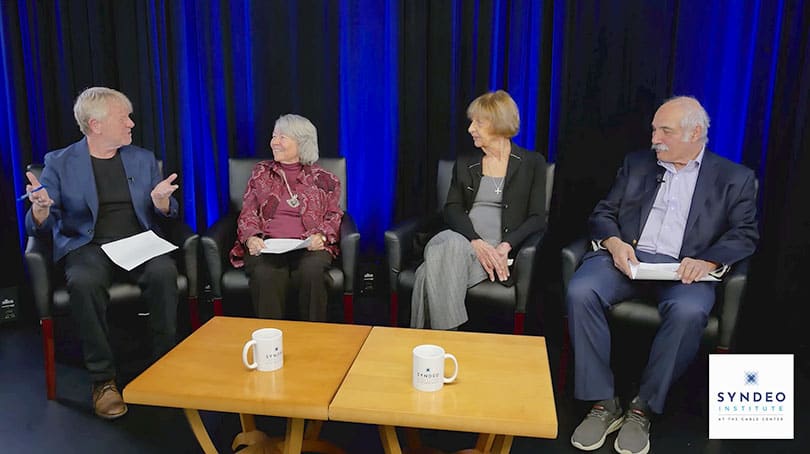
Interview Date: January 28, 2026
Moderator: Stewart Schley
Panelists: Priscilla Walker, June Travis, Ron Rizzuto
Abstract
At a January 28, 2026 Hauser Oral History Project panel at Denver’s Cable Center, moderator Stewart Schley speaks with former ATC executives June Travis and Priscilla Walker and University of Denver professor Ron Rizzuto about how ATC’s early-1980s shift to “decentralization” changed the company—and helped spark a landmark internal education program. ATC reorganized hundreds of systems into roughly 20 divisions, elevating system managers to division heads and stripping out layers of hierarchy so decisions could be made closer to local markets and customers. That structural change exposed skill gaps—especially around finance and accounting—so ATC created “Hamburger U,” a Denver-based, compressed MBA-like course (named after McDonald’s “Hamburger University”) focused primarily on finance, accounting, and negotiation. Walker and Travis enlisted Rizzuto and Leon Giles to help design and teach it, with an emphasis on practical, cable-relevant decision-making rather than abstract textbook learning.
The panel traces how Hamburger U’s approach migrated beyond ATC, most notably through Women in Cable management conferences that deliberately replaced generic business-school cases with cable-specific case studies and team-based problem solving across companies; the 1985 conference, for example, organized attendees into teams tackling marketing, financing, accounting, and management issues, and the model proved financially and professionally successful. Typical cases simulated real operator challenges—like system acquisitions, security/theft-of-service, and other fast-changing operational decisions—so participants could see how choices flowed through financials and operations. The panelists argue the enduring impact was cultural as much as technical: the program helped break down “silo-ization,” gave non-MBA managers confidence with business fundamentals, and “opened up the whole business” so employees could understand how their roles connected to the enterprise; negotiation training, in particular, was meant to equip newly empowered local leaders to contract and make deals once handled centrally.
Interview Transcript
STEWART SCHLEY: Greetings and good day. My name is Stewart Schley. I am here at the Syndeo Institute at the Cable Center for a really special episode of the Hauser Oral History Project, presented by the Cable Center. I say special because I’m with three individuals, not just one, who all are complicit and part of a fascinating and influential professional education program that took place in and around the cable industry starting in the early 1980s. Starting with the gentleman on my left, introduce yourself, please.
RON RIZZUTO: I’m Ron Rizzuto. I’m emeritus professor at the University of Denver and I was one of the faculty members who taught in the program.
SCHLEY: Beautiful.
JUNE TRAVIS: I’m June Travis. I’m a former cable television person. I started with ATC in about 1969, I suspect. And I spent most of my career there as a matter of fact.
PRISCILLA WALKER: I’m Priscilla Walker and I started in the cable television business in 1975 with ATC. And I was there for fourteen years, including working twice for June in decentralization and then — well, franchising and then decentralization.
SCHLEY: I appreciate you guys being here. Let’s start out by level setting ATC. (laughter) June, what was ATC? What are you talking about?
TRAVIS: ATC was American Television and Communications Corporation. And it was an early cable television company. We started, frankly, with a nucleus of systems that Bill Daniels had owned, and they were the nucleus of ATC, and Monty had worked for Bill Daniels, Monty Rifkin. He sort of moved across the street, took the cable systems with him, and Bill became our largest shareholder.
SCHLEY: What was the relationship between the publisher Time Inc. and ATC?
TRAVIS: Oh, some years later, Time Inc. acquired ATC.
SCHLEY: But it was originally independently owned cable company.
TRAVIS: We were an independent cable television company for a number of years, yeah.
SCHLEY: Okay. Priscilla, what was your introduction to ATC? How did that come about?
WALKER: Well, it was an employment agency that my husband had gotten a job and then they, for whatever reason because they did accounting, they contacted ATC, and so I interviewed Tom Crowley and Trygve Myhren, and that was in the marketing department initially. I had worked for an advertising agency in Denver before that. My first job out of college was reporting traffic on KOA Radio.
SCHLEY: No. (laughter) Did you know a thing about cable television before you took the job?
WALKER: Well, yeah. At the Mass Comm School at DU — it was that horrible thing that took broadcasting.
SCHLEY: How dare you.
WALKER: And actually, I talked to a family friend who owned the television station in Grand Junction to ask them if it was okay if I went to work for ATC.
SCHLEY: Just to get the blessing.
WALKER: And he said, “Oh yeah, it’s a wonderful company.”
SCHLEY: And I’m asking you to describe these early days of ATC as a prelude to really what is the subject of our conversation today. But around the early ’80s this company — I believe my timeframe is correct — began to rethink the way it managed its properties. We used the word, or you used the word, decentralization. What did that speak to?
WALKER: Well, let’s see. June was in charge of it. But basically, what we did is we took all of the hundreds of systems and created about twenty divisions and the system manager then became the head of the division. And so it kind of eliminated nine levels of structure in the company and made them in charge of their business, so they could make the business decisions. Which was a whole different way of doing business than traditional top-level corporate-run company.
SCHLEY: And I’ll ask June this question, why? What was the theory behind doing this?
TRAVIS: I think when we first started, we thought we could better serve our customers if decisions were made in the local market. Because markets differ from place to place and what worked extremely well in one, might not in another location. We decided that to serve our customer base in the most effective way, decision-making really needed to be more at the local level.
SCHLEY: It’s a great point because you had a number of prized properties, Syracuse, Florida, Hawaii.
TRAVIS: Correct.
SCHLEY: You were a pretty prominent cable company with operations everywhere.
WALKER: The biggest.
TRAVIS: Actually, you mentioned Hawaii, that was kind of a role model for ATC. They had, given their location, they had always run very independently, and we saw how effective they were in their community.
SCHLEY: Decentralization is an important thing because it spawned an interesting effort. Ron, you were involved in this from the early days, to try to figure out ways, if I’m expressing it properly, to help your division leaders better understand the business fundamentals of running the company. Is that a fair way to describe it?
WALKER: ATC had a lot of military men in operations, and they were used to following — doing what they were supposed to do.
SCHLEY: Very regimented.
WALKER: And I think there were eight or nine levels if you counted in the corporate office and then the region and then the system. I remember, it may have been when we were doing franchising or public affairs or whatever, that there was a problem in the system, and I contacted — I’m in the corporate office and I contacted somebody in the system to resolve the problem. I don’t know if it was a franchise question or something. And it was quite surprising in that environment that I would go from the corporate office directly to the person at the system level that I thought would be the one to resolve the question. So I thought decentralization would be a wonderful way of solving problems quickly because you knew who you could get an answer from.
SCHLEY: What sort of, I guess, surprised me or I didn’t realize it was you had really good operations people out in the field already, but not every operations person understood finance, accounting. Well, let’s get to the name first because we’ve gone too long. You created this corporate professional training program, curriculum, and you gave it a name. Ron, what did they call it?
RIZZUTO: Hamburger U.
SCHLEY: Why Hamburger U?
RIZZUTO: Joe Collins was familiar with it in terms of the training and he said, “We need our own Hamburger U,” I think is the story I heard. And so June had come to me and said, “How can we do this?”
SCHLEY: Hamburger U, sort of the famous McDonald’s Corporation training. It’s still — it’s on Randolph Avenue in Chicago; they run 5000 managers and franchisees through that program every year. It was sort of the shining star, right, of corporate education. So the inspiration was to bring the folks in from your regions, they live in Denver for a couple of weeks. What did they learn? What was the program?
TRAVIS: The primary focus was finance, accounting, and negotiation. And that’s what they spent their time learning for those few weeks. Then would take it back to the systems. The biggest change really was the fact — pushing the accounting function, or at least a certain portion of it, into the systems. That had always just been a corporate activity.
SCHLEY: On that note, Ron, you’ve taught thousands of students about accounting issues and finance issues. What was your role in this effort and how did it come about originally?
RIZZUTO: It came about because of June. June said, “Can you help us with this?” And she had gone through the executive MBA program at DU, so she knew myself and Leon Giles. So Leon and I, we stepped forward to help craft the program and then we then went on to teach it. So I taught as well as helped design the program.
SCHLEY: It, I think, has been expressed almost, I don’t want to say miniature, but a compressed MBA-style environment, where it’s a pretty deep, rich curriculum. How did you decide what classes or what subjects to focus in on?
TRAVIS: Actually, Joe Collins really was the lead on that. He was the head of operations at that point in time. But he had come up through being a system manager first before he went on to run ATC.
SCHLEY: From the ground level up, he knew — yeah, yeah.
TRAVIS: Absolutely. And he said, “If we’re going to decentralize, I can tell you where the weaknesses are.” He was fully supportive of the decentralization process, but he knew where the weaknesses were going to be.
SCHLEY: Professor, what was an example of perhaps a somewhat complex finance issue that you had to help people kind of walk through as they ran these cable divisions? What were they learning?
RIZZUTO: They didn’t have the background in accounting and so, the basics of accounting was designed to give them some intuition. You know, if you make this decision, how does it impact your financials. And then as we went through you then morphed to financial decision-making. There we hit on the idea with the people at ATC that it can’t be just textbook. Because we bought them a textbook and they had to read the textbook, but then we had to craft cases that were relevant. So we did that. And so all of us who were involved on the faculty, none of knew much about cable, so it was a way we learned, and then we were able to design the cases, whether it was theft of program or marketing. But it was all designed to be the textbook, but then the hands on.
SCHLEY: Because Ron, cable financially was a bit different of a beast, right? The industry lived on enormous capital expenditures, cash flow, and borrowings that supported that. Net profit wasn’t always the end game early on.
RIZZUTO: The industry taught us that, because we had come from a traditional accounting/finance background. And you’re right, net profit was the name of the game, but then we learned that cash flow was key, and so then we reeducated ourselves, and then we in turn used it so we could be relevant in the vernacular of the industry.
WALKER: I was allowed to take — even though I wasn’t a system manager, I was in the corporate office – and I went to Ron’s class. I learned the time value of money. That was something that just had — you know, you get a bill, and you pay it. (laughter) Maybe.
SCHLEY: But a key principle of cash flow management is time value of money. Priscilla, what was fun about putting this together and helping to orchestrate this program?
WALKER: Meeting the system people and just ensuring that the process worked as smoothly as it might. I remember going down to the mailroom in the corporate office and changing the names and the stuff —
SCHLEY: There’s always got to be a mailroom story, right? This is good. As a new group of students would come in.
WALKER: But the mailroom, as the systems became part of a division or as the divisions were established, the corporate offices set out the mail or whatever, so it had to be to the correct person at the correct location. The other thing that I thought was interesting was I got to do a newsletter called Strategy Digest where I interviewed the corporate people and talked about what their focus was, and then it went to the systems, to the divisions. And I even had, I won’t name his name, but one of the corporate people who was not in favor of decentralization, stopped me in the elevator one day and thanked me for the Strategy Digest publication. Because he understood things that he had not been aware of. So I’m a big proponent of putting the decision-making as close to the customers as possible.
SCHLEY: In that guise, how did you intuit, or know, or sense that the program was working? What were some of the — did you see improvements in the culture or the vibe of the company? What did you sort of perceive?
WALKER: Yeah. I think especially the system people were excited that all of the sudden they’re feeling more confident and they’re learning things that they didn’t know before.
SCHLEY: People like to learn.
WALKER: Yeah. And the connection. Again, it wasn’t the nine levels of management that you go through. The feedback, I guess, is what I thought was important.
SCHLEY: You get to an interesting point. I would have felt that what you’re perceiving is that your company is making an investment in you, in the person. Do you think that was part of the feedback loop, or whatever?
WALKER: Oh yeah. Yeah.
SCHLEY: We probably wouldn’t be talking about Hamburger U in isolation as a corporate, one-company training program if it didn’t sort of begin to permeate a broader sector, and a really broad sector of the industry. Talk about kind of this transformation where you took some of the principles of the program and exported them to a wider audience. Was it through the Women in Cable organization?
WALKER: Yes.
SCHLEY: What’s the history there?
WALKER: Okay. So starting in 1982, Woman in Cable — and June was one of the founders and on the national board starting in 1979. But in 1982 we had a management conference, again, to bring the women in cable together and give them programs, and speakers, and things to enhance their knowledge and connect. I mean, the network was a huge thing, and I think that helped us a lot. They had one in 1982 in Philadelphia with the Annenberg School of Communications. The whole idea that you aligned with a university for this was impressive. The seminars there were Cable Technology, Programming, Responsibility, Social Responsibility. 1983 was in Boston with professors from Harvard who did not understand the cable business. But they did case studies. And so those of us who worked in cable and knew, were able to teach them about cable. But it was really —
RIZZUTO: Let me just interject there that one of the typical kind of finance cases was a company called Browning Lumber and they used that case.
SCHLEY: Browning Lumber.
RIZZUTO: And so people studied Browning Lumber but then none of them had anything to do with the lumber business. So there, the idea of June and Priscilla, let’s take what we learn from Hamburger U and morph cases specific to the cable industry.
SCHLEY: Ron, were you part of this road show or this extrapolation of the program?
WALKER: Let me back up. In 1984 it was in Chicago, and again, I think it was Northwestern or something. And they also did live video so that people could call in and stuff. But they lost money. And so June was on the national board and the next year they said, “If we don’t make money we’re never going to do one of these again.”
SCHLEY: Yikes.
WALKER: And so June started out and it was going to be Managing Maturing Business, again, to reflect on the things that are happening in the industry. And she knew from Ron and Hamburger U that this is what we were going to do, cable-specific case studies. She spoke up at the national board meeting and said that’s what we were going to do. Then she called me and I had laryngitis. She told me that I had to be in charge of the program, and I couldn’t say no. (laughter)
RIZZUTO: No talk back there.
SCHLEY: You couldn’t say no. (laughter) Very savvy on June’s part.
WALKER: This was Ron and the absolute cable case studies, and we divided the people into four —
TRAVIS: Teams.
RIZZUTO: Skills.
WALKER: — teams. Which we identified with different colored sticky note on the nametag–
SCHLEY: You’re team orange.
WALKER: Team orange, blue, red. And the courses were Marketing, Financing, Accounting, and Management Issues. Those were the four topics.
SCHLEY: The teams were made up of people from different companies. There was a crosspollination.
WALKER: Hundreds of mostly women, although I did propose a name change at that time. I put up a — you know, then it was you put the piece of paper on the machine?
SCHLEY: Oh, I remember.
WALKER: Those? Yeah. So I put the Women in Cable logo up and I wrote, “And a few great guys.” (laughter)
SCHLEY: That was charitable of you. You guys both can comment on this, June and Priscilla. The industry was a male-dominated industry in the early ’80s, it perhaps still is, but were the captains and the leaders in the industry embracing of your ambitions and efforts with the Women in Cable organization?
WALKER: All but one. (laughter) Bill Daniels would come to our Rocky Mountain Chapter meetings and throw hundred-dollar bills into the donation jar – please — are you feeling — we need donations to get started.
TRAVIS: As did Bob Magness.
WALKER: And Bob Magness. And Glenn Jones, we were somewhere, he was talking, and all of the sudden he said, “Oh, and here’s a check for $25,000,” or something.
SCHLEY: Money where your mouth is.
TRAVIS: Yeah.
WALKER: Those were the three — and ATC. Obviously, we spent a lot of time and money getting Women in Cable into these things.
SCHLEY: One of the values, I think, of these discussions is kind of going back in time and dissecting what was going on in the industry. When you think of the early ’80s, you just mentioned the curriculum of four or five programming, marketing. What was going on in the industry in the early ’80s? We had this explosion of new channels, right? We had rising consumer demand.
WALKER: The “Thrilla in Manila.” We had satellite programming from Home Box Office.
SCHLEY: Game changing event.
WALKER: And instead of just broadcast or what you could microwave from nearby broadcast channels. And C-SPAN.
TRAVIS: Yeah.
SCHLEY: What did you observe, June, about the change that was occurring in the business around this sort of era, in the early days of the Women in Cable organization?
TRAVIS: I’m sorry?
SCHLEY: What was going in the industry? It was a go, go growth period, right?
TRAVIS: Oh, it was. We had just gone through a number of years of really aggressive franchising. And those were hard fought battles, but the industry really expanded very, very quickly. It just built system after system after system. Frankly, operations probably suffered a little bit.
SCHLEY: Huge challenges.
TRAVIS: Well, and our customer service clearly wasn’t what it should have been.
SCHLEY: You were trying to keep up with this.
TRAVIS: It was just keeping up. That was — like I said, it was kind of the convergence of all of those things that made centralization a logical choice at the time we started.
SCHLEY: Got you.
WALKER: And we had coaxial cable, which it would take — it was 50 phone lines to —
SCHLEY: Equate to, yeah.
WALKER: — equate the twisted copper. And duplicate up and back. It was not only —
SCHLEY: Bidirectional over time.
WALKER: So the programming — the Local O [origination]. That was another big push that you had.
SCHLEY: All these new concepts.
WALKER: Local origination that you had — the systems could have people come and broadcast –
SCHLEY: Wayne’s World.
WALKER: Yeah.
TRAVIS: Absolutely. A very different — different time.
WALKER: First of all, we could have thirteen — whatever the — we’re not the engineers. The technology side, we could have thirteen channels. Well, we filled those up pretty fast. CNN, and HBO, and all of those. Then they came up with new things, and fiber optics, and all of the stuff.
SCHLEY: It’s just ongoing iteration and progression. And Ron, from a finance standpoint, what was in the air? Just a continuing to raise capital to keep up with what Priscilla just described as this growth trajectory?
RIZZUTO: Continue to raise capital and borrow money. The industry got very good at that. But then the pace of change, you know, that — because one time you’re — one time the agenda is to hook up subscribers and then the next one is to begin to market to new subscribers. And in there we used to joke to the faculty in finance that we never use the same case twice because the industry changed.
TRAVIS: Oh yes.
RIZZUTO: So the pace of change. Then it was like being in a garden where you had the opportunity to apply the things that we’ve learned. Because there were so many applications of finance in the industry, so we really had a great opportunity to do that. And the people that Priscilla and June hooked us up with in the business, they were great teachers, and so we capitalized on their expertise that we could then tie to our academic background.
SCHLEY: That was my question. So the management conferences and the educational programs including and really starting with Hamburger U, my instructor wasn’t always an academic person, but sometimes a person from the core business, is that how you populated it?
WALKER: I taught a handful of courses.
SCHLEY: What did you teach? Marketing stuff?
WALKER: Yeah.
SCHLEY: You mentioned, June, that the operational challenges were mounting though at this point in time. For instance, just the customer — answering the phones, trying to keep customers happy, what were people dealing with in the field?
TRAVIS: Oh indeed. I think customer service was probably one of our biggest Achilles heels that we had. We didn’t have a very good reputation and we probably deserved that. But like I said, the focus was new franchising and continuing to expand. Because once a franchise was granted, you didn’t have a chance at that market again. So the focus was really very heavily on growth for a long period of time. And very little attention was paid to the operating side of the business, other than it spewed cash, which we needed to reinvest.
SCHLEY: What do you mean very little attention was paid to that side of the business?
TRAVIS: It was just run as — there wasn’t a lot of thought, I think, that we put into it. Not a lot of creativity. It was execution in a very narrow way.
SCHLEY: Well, you’re going to fast it’s hard to —
TRAVIS: Absolutely.
SCHLEY: — get outside of the box a little bit.
WALKER: And customer service. I mean, I think that absolutely there just needed to be more attention to customers. One of the first things I did in the marketing department was a very lengthy — you know, things used to be printed on wide green paper — yeah. And this was a study of how long customers stayed. And from a marketing standpoint, we learned that if a customer stayed at least three months, they’d stay a year. So focus on what we’re doing in those first three months.
SCHLEY: That interval.
WALKER: Yeah.
SCHLEY: I think that’s interesting. And I can’t resist — sideline segue for the younger people that are watching our presentation today. You’ve talked about publishing the newsletter. I forgot the name, Strategy?
WALKER: Strategy Digest. Yeah.
SCHLEY: What were the tools you were using to create a newsletter? Programming, computer, software?
WALKER: It was computers.
SCHLEY: Desktop publishing?
WALKER: Yeah.
SCHLEY: But early iterations, right?
WALKER: Yeah.
SCHLEY: On the finance side, the accounting side, Ron, were we Lotus 1-2-3 at this early era? Did Excel take over the world?
RIZZUTO: Not really. It was still a lot of hands on, but people began to use Excel and Lotus 1-2-3 and so that allowed us to ramp up the complexity of the cases. So there I think it was — we were all in a learning mode and you have an industry that there was no corporate training. So this was kind of everything was hand me down knowledge. Hamburger U helped facilitate that, I think.
WALKER: Although ATC had email. I forget the name of it, but I remember using it. You could be in contact with people in the systems —
SCHLEY: What a concept.
WALKER: — better than the Fax machine. It was an early — I forget the name of it. We hired somebody from IBM in the IT department and he knew what to do to make it happen. But I thought at the time, gee, I wish my mother-in-law was on this, (laughs) I could send emails.
SCHLEY: I remember it well. And it just seems so antiquated to talk about it right now when we’re connected all the time, 24/7. Did decentralization take hold beyond ATC in this industry? Maybe Ron, I’ll ask you, because you have the umbrella perspective a little bit.
RIZZUTO: I think it did. I mean, the various other corporations, they operated more centralized. But it was still very much — I guess I would say ATC was the first to really move forward and systematize decentralization. Other organizations, they were more ad hoc. Cox was always one where they had a corporate learning group and a lot of corporate things. Then you didn’t have — you had Women in Cable as an organization trying to do this, but you had CTAM. But CTAM wasn’t as comprehensive in terms of the case studies and things.
SCHLEY: CTAM being an industry marketing association.
WALKER: Television —
TRAVIS: Marketing.
WALKER: — Marketing.
TRAVIS: Association.
WALKER: Yes.
SCHLEY: I asked the question because I’m trying to create this sort of lineage. Had ATC not embraced this concept of decentralization, I’m not sure that you do Hamburger University. That was an impetus, right? Or a driver?
TRAVIS: Right. I think that’s true. The whole concept was started to help our division presidents be successful. When it went out to the broader industry, as Priscilla said, through Women in Cable — actually, as I recall, the case studies were not based on ATC or the way it did accounting, it was much more generic, because other companies didn’t want to adopt what ATC did, so those case studies were —
WALKER: Well, we made up names. We may have used —
SCHLEY: Fictional names of companies?
WALKER: Alpha Cable was one. It wasn’t Adelphi, it was Alpha. They were — Ron was able to take the finance/accounting stuff and turn it into kind of a general —
TRAVIS: Generic.
WALKER: — generic. So Women in Cable did their management conferences and in 1985, Ron did ours with the case studies, the cable specific case studies. And it was so successful, we made almost $60,000, because we did cheap things like colored name tags.
SCHLEY: You got to do what you got to do. Can you describe one case study? Were you creating problems that the teams then had to solve? What would have been a problem?
WALKER: What was your favorite?
RIZZUTO: Well, a couple would be, one, the system is going to go out and acquire another system. So then, what did you have to do to sort of get ready for that and what sort of integration kinds of issues. That was a favorite one. Then the engineering was another one because there the industry was — they had a one-way system and the security was using traps. And so when you went to a different security system, what did you have to know about that in order to launch it. The industry was also very focused on theft of service and so, what did you have to do to cut back on the theft of service. It was a very easy setup from a finance standpoint. So what were you paying for someone on the theft detection side, and what were you getting in terms of customers. They were a lot like that, but I would say the acquisition was the one that we used most in terms of people learning how to do it.
SCHLEY: I’ve got to say, Ron, I mean, I’m a writer, not an accounting or a businessperson, it sounds grueling. These were not easy cases to battle through. And they weren’t easy in the real world, June, either. Obviously.
TRAVIS: No. I mean, they weren’t insurmountable, but they were complex enough to make you think.
WALKER: And what was interesting was with the different people with different backgrounds and the different —
TRAVIS: Right.
WALKER: — tables, groups, that they’d have different solutions. They’d come up with different ideas. So they were learning from each other from their solution to the case.
SCHLEY: Part of the magic of the communal effort.
TRAVIS: In fact, that was probably one of the biggest outcomes, positive outcomes, is the fact that it’s easy in an industry to sort of be channeled. You know your job and nobody else’s, and you don’t even know how what you do impacts another —
SCHLEY: Sure. Silo-ization.
TRAVIS: And what this did, basically, was open up the whole business to all employees. And that was a huge benefit because it finally made sense. They felt a part of the whole as opposed to isolated.
SCHLEY: I guess what I was alluding to, June, when somebody is making an investment in you, now you’re getting a more holistic picture of “what business am I in, what am I contributing?”
TRAVIS: Absolutely.
RIZZUTO: And, you know, maybe talk a little bit about how you leveraged the systems that had already rolled out and the division presidents and people would come in and be resources for this. So [Thomas] Rackerby and Kevin Rourke, they would come in — I’ll let June tell you about who these people were.
TRAVIS: They were our early, early division presidents. That’s for sure.
SCHLEY: They’re the educated — they’ve already been through the ringer.
TRAVIS: Indeed. And they were the trailblazers, frankly. A couple of them.
RIZZUTO: Without the benefit of Hamburger U. So we used their experience to migrate and set the tone for what Hamburger U should do.
SCHLEY: I can’t resist but ask June, because you’re sort of our connection to the psyche of the system manager, but when you talk about the acquisition case study, we’re going to have to integrate this new system, and they do things differently, and they have different converter boxes, and their billing system is not compatible with ours. From the standpoint of a manager, a division president, you want to grow, you want to nurture and make this business work. But at the same time, some nights had to be long nights trying to work through these combinations, which happened all over the industry, right? Fatigue. Fatigues me just talking about it.
TRAVIS: I think so. But we were blessed. We had some very, very smart people, who frankly, given the tools did one great job. I mean, they just — it was kind of cutting them loose. Sure, I think there were challenges because you’re all of the sudden, you’re responsible, and that’s a little bit different than saying, “Gee, I did what corporate told me and it didn’t work.” But it was a challenge they loved because they felt they had control over their own destiny.
SCHLEY: Lovely. And as you went through this progression of widening the reach and influence of Hamburger U into the broader industry, who were — I’ll start with you, Priscilla — a couple of people who were instrumental and meaningful for you in your career in sort of helping to make this happen? Who comes to mind? Putting you on the spot here.
WALKER: Let’s see. The Women in Cable board, and I was on it for four years, was very supportive. One of the things that we were focusing on was getting women in senior management. There were just very few instances where that was happening. The executives were telling their employees that they don’t know enough about the business or whatever. So this was a broadening kind of thing, especially for operations jobs. In fact, I think I said before that Diane Blackwood got to be in operations in North Carolina because she’d been through the certificate program, and the case studies, and she had the experience, so she just walked in and was very successful.
SCHLEY: It’s a testament to the program itself but also, it’s a reminder of people power. This business really — I guess maybe all businesses, but in a world that sometimes seems mechanistic it’s nice to talk to you about having imbued human beings with resources, and intelligence, and experience. How about you, June? When you think of the Hamburger U journey and the Women in Cable management conference program, who rises to the top in your world when you think about that? People?
TRAVIS: People? In relation to that program?
SCHLEY: Sure.
TRAVIS: Priscilla. (laughter)
SCHLEY: Okay, that’s why you’re here.
TRAVIS: She did a masterful job of taking it and really running with it and broadened it well beyond ATC.
SCHLEY: Did you feel you had ownership, you had a lot of purview to exert your influence on the program?
WALKER: Oh yeah.
SCHLEY: Which is huge, right?
WALKER: Can I tell you the story about the 1986 one, which was in Atlanta? We made money in Denver and gotten across Ron and how valuable he was and the case studies and stuff. So I attended the planning conference, it was going to be in Atlanta. In this meeting, the ones that I remember, Terri Thompson who was the head of the chapter, I think, and worked at Cox Cable — just a calm, wonderful influence. And Gail Sermersheim, who was the head of Home Box Office in Atlanta. They had brought in professor from some university, I’m not going to remember the name or where, and they’re more fashion conscious in Atlanta than perhaps I was.
SCHLEY: I see, okay.
WALKER: So they’ve got to have something more than color name tags. I don’t remember what they were talking about, maybe scarves or something that was more expensive, but fashionable. And the professor honestly said, “How about aprons?”(laughter)
SCHLEY: No.
WALKER: Yeah. So I burst out laughing. I have one of those laughs that is uncontrollable. I stopped the first one and I looked up and here is Terri Thompson, who has this look, and (laugh) some more. Then it was the end of the meeting and the professor left. I said, “Why not Ron? Let’s continue this.” So that was the next one that you did was in Atlanta. And then it just went on from there. Then led to the Certificate in Cable. It was so successful, and the women were being successful. There were some men as well. But they were being more successful in their careers because they had access to the knowledge that they needed to do a better job.
SCHLEY: Right. And this is why you do get corporate buy in and corporate support, because your people are getting better at what they do. How long were you involved, Ron, in the management conference series?
RIZZUTO: I was involved in the management conference until 2006, you know, there — the management conference had a focus when I was involved on developing skills. And then as WIC changed to more of a leadership strategy, there was less need for my involvement. But from the beginning when we did the 1985 conference until 2006.
WALKER: And then I think the management of — the people that were on the board for Women in Cable had changed. And Jones University had taken off and so I think that was one of the decisions for why they stopped doing the —
TRAVIS: You have to put this in context of the time and the industry as well. Before we started this process, cable systems had technicians and accountants. That’s what we employed. We didn’t have marketing departments and personnel departments and all of those other things. The learning curve for both men and women in the industry was really to say, how do all of these pieces fit together. These are new pieces to us and they weren’t things that were intuitive because it was largely a technical business for a number of years and that’s where the focus was.
SCHLEY: I love you articulating that the business — the heritage was technicians and accountants. Because it’s true, right?
WALKER: Oh absolutely.
SCHLEY: And I’m not sure that’s fully realized or — because it’s different.
TRAVIS: And that’s how it began.
SCHLEY: Sure. Wires and amplifiers.
TRAVIS: That’s right.
SCHLEY: And paper invoices. I don’t know what you all used to do to get paid. Ron, you worked with so many academics who participated in the management conference and have been also aligned with you in some other focused work around the Cable Center. What was interesting about cable communications from an academic perspective? What sort of drew people to the line of inquiry?
RIZZUTO: I think that one, it was fast-paced. And academics were always interested in real world problems, but then you see this real-world problem and you say, geez, this is really real world. So you see the challenge and so, it’s the adrenaline of trying to figure out what are the piece parts. Because you could see it’s one thing if we’re going to market this or we’re going to work on a new acquisition, but how do you pull all those parts together. And I think this is what June and Priscilla did, is they brought in managers who were smart and they were used to integrative or beginning to integrate. And so I think that was really the interest in doing it. Because it was really a playground for me in terms of working on real world problems.
SCHLEY: Yeah. Very current, very topical. Flash forward —
WALKER: Not boring.
SCHLEY: Not boring, no. I’d definitely take that out of this conversation. Fast forward to today, 2026. In this industry, and its changed enormously, we have consolidation, we have fewer larger companies, we have competitors that never existed back in the early days. Do you feel there’s still a need for a Hamburger U type of proposition? Or does everybody already know everything? What’s your sense about where we are today?
TRAVIS: I’m so dated. I have no idea what’s going on in the industry right now. My sense is education; there’s always a place for education in any business at any time. There’s always something you can learn.
WALKER: The challenge today is streaming. The competition is so different than it was, you know, twenty years ago.
SCHLEY: Who knew?
WALKER: What do you carry and what will people pay for? For the Certificate program and Women in Cable, we were big on surveys. We would survey the people who had come and customers and focus groups and things like that.
SCHLEY: On consumer surveys?
WALKER: Yeah. As well as how effective were the programs. Maybe they should do that.
SCHLEY: I’m sure some of that goes on at a high level. I guess my point is, in an industry that began with technicians and accountants, probably newcomers in the business today may be more grounded in finance, may be more grounded in accounting or marketing principles. It’s a changed world. And yet there was, I think, profound influence from what you guys did on the business. You said something so interesting about you had this time and money calculation where there was the three-month interval and if you could keep somebody after month three, they’d stick with you. There was no streaming at that time.
WALKER: No.
SCHLEY: There was no satellite television in 1983. DirecTV launched in 1994. We had the field of play kind of to ourselves. Why did people disconnect at all? What was the motivation?
WALKER: The lack of programming, I think. In a lot of places we had, in 1975, three channels, and then launching some of the new ones. Yeah, there wasn’t —
SCHLEY: So they were just tired of the —
WALKER: — competition. Occasionally there would be — you wrote the book about —
RIZZUTO: Overbuilds.
WALKER: Overbuilds.
SCHLEY: City — municipal overbuilds.
WALKER: And they all lost money because they didn’t know how to — and the finance,- he could tell you better than I can, – but you really have to pass — you have to have more than have of the passings as customers. And I think that now with the streaming and the fiber and stuff that’s coming up —
SCHLEY: It’s hard to get fifty percent share these days.
WALKER: And what’s their future? Because cable does more. (laughs)
RIZZUTO: But I think the one thing that’s changed the propositions for overbuilders is now they have more products than just video. Then you can append that to the technology provides services for the city. So it’s a different proposition, but still it’s tough on the overbuild side.
SCHLEY: It’s a great point though, Ron. And that applies to even corporate competitors. Maybe you sell three or four different fiber internet connectivity, telephony, video, security services, maybe you don’t need the fifty percent hurdle to be met these days. The big picture question, it’s been fun to talk about the legacy and the heritage of this program, and when you do sit down and talk about it, what would you point to — I’ll start with Ron — as an ongoing impact of what you concocted with Hamburger U and with the WIC management conference program?
RIZZUTO: I think it unleashed in the industry the creativity. People who didn’t have the formal education, they learned enough, and they learned this is not rocket science. You can learn it, and you can figure out how to sort of view the whole problem rather than just the technical parts of it. I think it’s empowered a lot of people in the industry. And in there I have one of the things we haven’t talked about that I want June and Priscilla to talk about is one of the modules in the course was negotiations, and why was that in there. But I think it’s really empowered people to really improve their skillset and know that they can do it. And just because they don’t have the formal background, they can learn it.
SCHLEY: Some people are daunted by accounting and finance issues. You’ve helped to make that a safe place for people to understand and to integrate into their professional lives. Negotiation, why was that part of the curriculum?
TRAVIS: Originally I think Joe felt that if you’re making the decisions at the local level, you need to have some skills to enter into contracts and agreements with all of the things that businesses need to run. Again, that had been centralized and everything shipped out, and instead the division presidents and their staff needed to make those decisions on the local level, and they needed the confidence to be able to go out and talk to another company or provider of a service and negotiate a deal.
SCHLEY: Did that trace all of the way to, for instance, procurement of technical equipment and gear? Did that used to be centralized or did it remain kind of centralized?
TRAVIS: It had been centralized completely, yes. To some extent, sure. We’d have master contracts, there’s no question, just from a pricing standpoint. Like with programming, you would have a master contract because you would get a much better deal than if each system negotiated with programmers individually.
SCHLEY: I’m glad you brought that up.
WALKER: There might have been some regional or like local —
TRAVIS: There was some regional sports and stuff like that, the channels.
WALKER: They would had to have done on the programming side.
TRAVIS: Right.
SCHLEY: But Priscilla, to piggyback on that maybe not a well understood fact, there was diversity of programming channel lineups by system, or market, or division. Maybe what played in Peoria didn’t play in Hollywood. I don’t know. How did — with decentralization, the system management had a pretty big say, right, in what goes on Channel 37 of the cable system.
WALKER: Yeah. I mean, part of it was what they had and where it was. The philosophy of do you put all the broadcasts together and all the sports together, there’s a whole lot of that.
SCHLEY: Different strokes for different folks though, right? It varied.
WALKER: And franchise negotiation. That would be the other thing.
TRAVIS: That would be the other one, yeah.
WALKER: They typically are fifteen years or whatever and then you’ve got the system built. Because you have to build it before you can offer any programming. And then you’ve got it for fifteen years and then they come back and say, “Oh gee, we want to renew it.” When I was working after ATC, I had my own marketing and advertising business, and I worked a lot on franchise proposals. We had done 125 in three years at ATC – and I got to do the Manhattan renewal franchise proposal.
SCHLEY: How thick was that document?
WALKER: Thirteen notebooks. Actually, the Cable Center has my copy. (laughs)
SCHLEY: I’m glad you survived that odyssey. We talked about the heritage of localism and the way the industry progressed and transformed and mutated over the years, partly with propellent and help from what you guys did. What do you see, I’ll start Ron, with you, the industry as changed so much, video is no longer the centerpiece of the economics, we have broadband competitors, multiple players in a market, if you’re starting Hamburger U today, what do you focus on, and where do you see this business progressing?
RIZZUTO: Well, I think you’ve got to focus — you know, if you look at you’re running a system, you really need to be much deeper in terms of the products that you’re offering. Because you now are offering mobile, you’re offering phone, and you’re offering video, and you’re offering broadband. So you need to have a command of all of that. And in there, instead of growing video, you may in fact find some people eliminating video. So it’s much more an effort of figuring out where you’re going to compete and how you’re going to compete as opposed to doing everything for everybody. You may have a much narrower niche that you’re offering, but it’s important to be tied into the local community with that.
SCHLEY: June, do you agree? Do you feel that localism is still part of the calling card for cable? Do you worry that we’ve lost something there?
TRAVIS: I think the companies have gotten so large and the product offerings so much more diverse, I think there’s been a natural progression away from localism. Clearly there are feet on the ground in each, but the competition is now a national competition as opposed to a local competition.
SCHLEY: Well said. If Priscilla Walker is entering this industry today, and you’re a marketing guru and a savant, but you have all of these multiplicity of products today, how would you approach your career differently, do you think?
WALKER: Well, let’s see. You’re asking what I’d do. Public relations, customer service, marketing, those things are key. I think I would still try and get, again, the best customer feedback. One of the problems – decentralization at ATC went away. There aren’t decentralized companies now. It’s corporate office. That’s, again — but the feet are everywhere else. And I think it’s got to be — there should still be a focus on customers and that they’re happy and figure out what can be done differently. I don’t even know the name of the system manager where I live. (laughs)
TRAVIS: Likewise.
WALKER: I did work for them when I was consulting years ago. But I don’t know the new people.
SCHLEY: It’s a yin and yang. It’s almost like we’re sort of back to the future, if you will. We decentralized, now I think the spectrum or the tide has turned —
RIZZUTO: Yeah. We sort of decentralized and — I mean, the industry decentralized and then now we’re centralizing, and we now need to find the right mix of centralization and decentralization. Because pure decentralization doesn’t work, but similarly mass centralization doesn’t work either. So I think a recalibration of that.
SCHLEY: Recalibration. Excellent perspectives. Thank you, guys. Parting thoughts from you, Priscilla? What are you proud of in association with this educational effort?
WALKER: Oh, just to be part of something that was so successful, and appreciative, and you could see — there’s a lot of things that you do in your life that you don’t get much feedback, or you don’t think that you made a difference.
SCHLEY: You’re flying solo. Yeah.
WALKER: But this was clearly something that changed people’s lives for the better hopefully. Mostly. (laughs)
SCHLEY: That is a great closing observation. I want to thank this trio of wonderful people, Ron, June, Priscilla, for kind of going back in time and talking about what I really think was kind of a seminal effort that had broad influence on an entire industry. Thank you for tuning in and learning. For the Syndeo Institute at the Cable Center, I’m Stewart Schley and we will see you soon.