

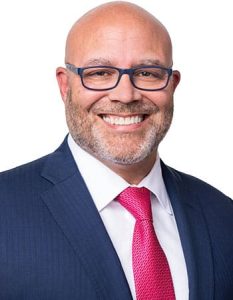
Interview Date: September 12, 2025
Interviewer: Seth Arenstein
Abstract
The oral history of Michael K. Powell, recorded for the Hauser Oral History Project on September 12, 2025, offers a reflective account of his distinguished career as a public servant, policymaker, and leader in technology and telecommunications. Powell traces his life from his childhood in a military family—marked by resilience, discipline, and mobility—to his years at the College of William & Mary, where formative leadership experiences and ROTC service shaped his worldview. His early career in the U.S. Army, including service as an armored cavalry officer during the Cold War, provided the foundation for his enduring leadership philosophy centered on preparation, accountability, and care for one’s people. Transitioning from military to civilian life, Powell recounts his studies at Georgetown Law, his clerkship under Judge Henry Edwards, and his mentorship by civil rights attorney William T. Coleman, all of which instilled in him an enduring commitment to excellence, intellectual rigor, and public service.
Powell’s narrative continues through his rise as Chairman of the Federal Communications Commission (FCC) at age 38 and later as President and CEO of NCTA – The Internet & Television Association, where he spent fifteen years transforming the industry’s image and strategic direction. He emphasizes his role in redefining the cable industry’s story—from a defensive posture to one of innovation, pride, and national contribution—while spearheading initiatives like the “10G” vision and promoting customer service transformation. His reflections also explore adaptive leadership through crises, notably the COVID-19 pandemic, and the importance of compassion, delegation, and narrative in modern organizational culture. Beyond telecommunications, Powell’s service on the Mayo Clinic Board of Trustees, where he advanced the institution’s patient-first values, reinforces his belief in mission-driven leadership. Closing with insights on technology’s future—especially AI’s transformative potential—Powell views his legacy not as personal achievement but as the cultivation of values and institutions prepared to meet the next frontier of innovation.
Interview Transcript
SETH ARENSTEIN: Hi, I’m Seth Arenstein. I’m here for the Hauser Oral History Project for the Cable Center. It’s September 12th, 2025. We’re in Washington, D.C., at the headquarters of NCTA – The Internet & Television Association. And our guest, our oral history is for Michael Powell, the President and CEO of NCTA. Michael, welcome.
MICHAEL POWELL: Good to see you.
ARENSTEIN: Welcome.
POWELL: Thank you.
ARENSTEIN: For ten more days, right?
POWELL: For ten more days, yeah.
ARENSTEIN: (laughs) Okay, so you just announced your retirement.
POWELL: Yes.
ARENSTEIN: How do you feel about that? Is it a big weight off your shoulders?
POWELL: No, I wouldn’t put it that way. I think — I think changes and endings are complex emotionally. I’ve had an enormously positive time here, I love being here, but I have strong views about you ought to know when it’s time to move on, and so I’m excited about the next chapter of my life, as well.
ARENSTEIN: Great. You know, I’m going to go a little bit out of order. Normally, we start with where you were born and your education, (laughter) but I’m going to ask you, because I saw a quote that was attributed to you, and you said you were going to — you planned on staying at NCTA for about three to five years, and now it’s been, what, 15?
POWELL: Almost, yeah.
ARENSTEIN: What happened? (laughs)
POWELL: What happened? Joy happened. You know, I think there’s a tendency in our society to just be continually ambitious, that you’re supposed to do jobs, check that box, and climb a ladder, and I think one of the things that happens at NCTA is you fall in love with it. Your life is well-balanced. The work is intellectually challenging. The people are nourishing and fantastic colleagues and friends. And you start asking yourself, well, what’s the reason for going somewhere else, if you’re fully satisfied, and you have what the kids always say they want, purpose and meaning? And then, believe it or not, one day you just wake up and the years have gone by. So that’s what happened. As I said in the speech the other day, I stayed because it’s good for my soul.
ARENSTEIN: Wow. Well, nothing better than that, I guess.
POWELL: Yeah.
ARENSTEIN: So let’s start at the beginning. Where were you born? And tell me a little bit about your childhood.
POWELL: Well, I was born in Birmingham, Alabama in 1963, a pretty storied year in Birmingham, Alabama. My mother was from there, and she had returned home to give birth to me, because my father was in Vietnam, and I didn’t meet my father till I was ten months old. So we were in Birmingham during that tumultuous year, Civil Rights year. In fact, my mother told me later in life that we were in church, her with her new infant son, when the 16th Street Baptist Church exploded just down the block, killing those four little girls, who my mother knew extremely well. So, you know, I was born in the midst of that conflagration. My father came home from Vietnam, and our life started together as a family, and we moved around, as Army families do. And then, ultimately, my great two sisters came along, my war buddies, who we spent time in the back of many a station wagon on the way across the country to somewhere. That’s why they’re my best buddies to this day. And, you know, my father had, of course, a meteoric rise in the Army, and we were constantly moving, so we just sort of had that life. My parents were very good about, you know — you move to Fort Campbell, Kentucky; she’d kick you out the door and say, “Go find friends.” And the three of us would literally go door to door, ringing doorbells —
ARENSTEIN: Wow.
POWELL: — asking if you had anybody our age to play with. And so that was kind of our fun life. And, you know, we had the good fortune a few times of living in a few places for a very long time, including Virginia and Washington, D.C., where he was often brought back to, seemingly continuously. And then I graduated high school and went to the College of William & Mary, which I love dearly to this day. I had a wonderful experience there. Third day of freshman year, I met my girlfriend, now wife of 37 years.
ARENSTEIN: Wow.
POWELL: Never looked back. So it means a lot to me. My two sisters ended up following me. They both went to William & Mary, as well. My dad liked that. We were all in the same place; (laughs) we could be found while he moved around. So I had a very happy childhood, very satisfying, one with lots of exciting experiences.
ARENSTEIN: Now, I noticed you glossed over your high school.
POWELL: Ah.
ARENSTEIN: Lake Braddock?
POWELL: Yes.
ARENSTEIN: Okay.
POWELL: I was a Lake Braddock Bruin. It was one of the experimental schools in the Northern Virginia area that was seventh grade through 12th grade. We moved into the area when I was going into the ninth grade, so I started in the high school, and had a really rich high school time. I mean, two activities consumed most of my time. The first was sports — I was a high school gymnast, and captain of the gymnastics team for four years, at Lake Braddock, which was really fun, and unusual — men’s gymnastics wasn’t prevalent in all the high schools in the area, so it was a pretty interesting and fun thing to do. And then, believe it or not, I was very big in the theater in high school. Not only did I perform a number of times, but I really enjoyed being a stage manager, and on the production side. And we had a very structured high school theater program, where you could get promoted, and there were ranks. And in my senior year I was the supervisory stage manager, meaning I was in charge of the whole theater, and learned to do lighting design. And, in fact, I had decided to go to college, I was debating between pursuing an Army career or becoming a Broadway lighting designer, which my dad was humored by. And so when we visited colleges, we went to both. We went to theater schools, and we went to West Point. And, ultimately, I chose the place where I thought I could do both, but I mostly ended up doing ROTC for the rest of my… (laughs)
ARENSTEIN: Did your father — did he like the idea of possibly you becoming a lighting designer?
POWELL: I don’t know if he liked it. He was completely comfortable with it. My father was great in find your own path. He never, ever pushed, or hinted, or suggested that I do anything. You would think that he would say, “Oh, I’d love you to go in the Army like me.” I don’t ever remember having that impression. I mean, I think he was proud that you would, but he was perfectly happy if you didn’t. You know, he didn’t go to West Point. He’s an ROTC guy like me. So, you know, he wasn’t romantically, you know, trying to drive you there. I was lucky: I won a four-year ROTC scholarship, which meant I could go free to a civilian university, and not just the benefits of West Point. I did get into West Point, and I ultimately decided instead to go to William & Mary, where… So I went on a four-year ROTC scholarship, knowing that I would finish and go into the service, though. He was proud of that, but he never, ever pushed that.
ARENSTEIN: Huh. What drew you to William & Mary, as opposed to West Point?
POWELL: (laughs) Well, as opposed to West Point is easy. I think at the time — I don’t even think women were admitted to West Point yet; I don’t quite remember. But the problem with West Point is that, at 18 years old, you’re being asked not only to go to West Point but to make a firm commitment to five years after it, so you’re sort of making a nine-, ten-year decision, and that seemed pretty daunting to me at the time. You know, of course, West Point itself is like being in the Army. You’re fully immersed in the Cadet Corps, the Long Gray Line, wearing uniforms every day. William & Mary seemed, to me, to offer a kind of richer variety of experiences. There were women, which ended up paying off for me. You know, there was a wider range of things to study. And while — you had two years before you made a commitment to the service, so you had a little bit of space, and I liked that. So, you know, I got the fraternity experience. I got other experiences on campus that were rich and satisfying, and that decision I’ve never regretted. That worked out well. And so I was able to be commissioned a regular Army officer from William & Mary just as easily as I would from West Point.
ARENSTEIN: Talk a little bit about William & Mary. I know it’s — a lot of people don’t know too much about it, but it’s got a great history.
POWELL: It’s a beautiful history.
ARENSTEIN: And a beautiful campus.
POWELL: Yeah. We like to say it’s the oldest university in the United States. Harvard argues with us about that. Harvard really was the first college. William & Mary says it’s the first university, because it was the first school to have a law school, for example, or graduate programs. Either way you count it, it’s old. It predates the Republic. It was founded in 1693, chartered by King William and Queen Mary. It still, technically, owns a British charter, even though it’s really a Virginia state school, but every now and then the Royals actually come to William & Mary to pay their homage to the colonial heritage of the school. It sits in Colonial Williamsburg, with the same character of the town, you know, with some… It has the oldest academic building in the country, the Wren Building, which was designed by Sir Christopher Wren, and filled with storied students. Thomas Jefferson was a student at William & Mary, graduated from there, as was, I believe, James Madison. George Washington was the chancellor and the rector, which is exciting because I was the rector.
ARENSTEIN: That’s right, I was going to say.
POWELL: And so I like to say, you know, my predecessor was George Washington. We had many, many presidents, who became presidents, who went to William & Mary. At one point, it was the most of any university; I don’t know if that’s still true. So it’s a beautiful, idyllic campus, with a colonial flavor. It’s very manageable, as a student. You know, I liked that. It was 5,000 students. You know, by the time you were a senior, I wouldn’t say you knew them all, but you recognized them all, and you knew a lot of them. And so it let you really feel safe, comfortable, with good friendships. And I’ve been involved with it ever since, in every capacity you can imagine.
ARENSTEIN: Right. Let’s also — before we move on, let’s talk a little bit about your mom, and her influence on you.
POWELL: My mother was everything. You know, when you’re in a military family, particularly when there are a few periods of actual war — my father went to Vietnam twice — and, you know, you don’t realize it as a kid, but as an adult, I think back on — that’s a year with no father. You don’t see him. And we didn’t realize, but she realized, any day now that some guy could come to your front door in dress blue uniform with a telegram to tell you… In fact, he was hurt twice, pretty significantly, and people did come to the house with a telegram, and, you know, you’re hoping and praying it’s not the end of him, and it never was, thank God, but it was the injury of him. So she soldiered through that at least two years with young children, who she kept safe from that fear. He also had a command once in the ’70s in Korea, which you weren’t allowed to take your family, so it was the equivalent of going to war. He also left for a year without us around, so she, you know, took care of us. I like to say my mother taught me to throw a baseball. I can see us in the side yard with her playing — with a glove on her hand, playing catch with me. She’s the one who took me to Little League, long before he got involved. She really was there at these formative moments. She was loving, and the — she was the most… I — everybody always asks me — I’ve introduced her many times, and the word that I always say is “grace.” She had a quiet strength, a beauty that just emanated. She was incredibly fashionable. You could not find a picture of me as a child when I am not wearing a double-breasted suit with tie and shirt. Every photo I had in — you know, you see these school pictures of first graders today, and, you know, they’re wearing football jerseys and t-shirts. Not me. I was nappy in my button-down, you know, jacket and suit and tie. I never was allowed to take a picture that way. So we were classy in that way. She thought it was really important. And she just was a godsend to me, even later in life, when she was in her eighties and slowly fading, you know, and I’d go see her, and there’s just nothing better than cozying up and put my head on my mommy’s shoulder. You know, she was… She was the love of our life. And she saw everything. She saw the world. She went to every country in the world with my dad. But she never, ever lost that girl from Alabama kind of feel to her. The world would be better with more people like her in it.
ARENSTEIN: Sounds like it. Absolutely. So let’s move on now. You’ve — let’s say you’ve graduated from William & Mary. What’s your next step?
POWELL: Well, fortunately, it was mostly laid out for me. I graduated from William & Mary, having done well in ROTC, and won a full commission as a regular Army officer. I had my choice of branches because I had graduated the top of my class, so I picked the Armor Branch, I was a tanker, and armored cavalry. So at first I had a couple of assignments, just getting ready to go to what we call Officer Basic School, where you learn how to be an Armor officer. I was at Fort Bragg, North Carolina, at the 82nd Airborne, and got to do some paratrooper — I was a paratrooper. I had qualified. I was jumping out of airplanes. I also went to Air Assault School at Fort Campbell, Kentucky in between, on the way to Fort Knox, Kentucky, where the Armor School was. So I went, six months of Armor School. I was fortunate. I graduated first in my class from the Armor School, which also let me choose my favorite assignment, so I chose one of the most elite cavalry units in Germany, the 2nd Armored Cavalry Regiment, which was George S. Patton’s regiment. And so I went to Germany as a young, you know, butter bar, as we’d say, lieutenant. At William & Mary, I was commissioned; my father commissioned me, and the rest of the class. He was a two-star general at that point, so that was wonderful. And off I went. And I was a platoon leader in the 2nd Armored Cavalry Regiment in Germany, in command of 46 wonderful soldiers, at a time — we’re at the Cold War — where it was real. And we guarded a border, so we were responsible for the stretch of border in the trizonal point: Austria, Czechoslovakia, and Southern Germany. And so our sector — and so we used to — we were responsible for watching that border and being prepared for a war in which we expected the Soviets would come rolling over that border, we would probably see them first, or our sister cavalry unit in the north, the 11th Armored Cavalry Regiment, the famous Blackhorse, you know, in the Fulda Gap, where we would expect the Soviets. So we were just the first line of defense of the United States in Europe. I could get into that whole experience, but —
ARENSTEIN: Well, I —
POWELL: — that’s what came next.
ARENSTEIN: Right, but what I’d like to eventually get into, but we can preview it here, is I know your views on leadership are very important.
POWELL: Mm-hmm.
ARENSTEIN: You consider yourself the CEO — you are the CEO, but you really consider yourself a CEO, as opposed to a lobbyist, and you are very adamant about that, before taking the job, as I recall reading.
POWELL: Yeah.
ARENSTEIN: But tell me a little bit about leading 46 soldiers, and how some of the leadership qualities that you must have learned in the military — do you still hold on to them today? And how they affect your career — how they affected your career.
POWELL: Yeah, it’s a great question. You know, I think it was the greatest leadership training I’ve ever had, or anyone could have. You show up in a foreign country, in the dead of winter. You report to your commander. You’re told, “This is your platoon.” There are 46 men, who range from the age of 17 or 18, who are often running away from something, or only — never been to another, foreign country, joined the Army instead of something else; all the way up to your platoon sergeant, who’s probably around 46 years old to your 22, has probably been in the Army 15 years, and he works for you, too. So you have this enormous diversity of experiences. You’re legally responsible for them all. And a bunch of them — and every last one of them are essentially your teachers. You don’t know anything, but yet you’re responsible for everything. And how are you going to do that? You’re going to have to win the respect, the trust, the commitment, maybe even bordering on the love of these soldiers so they will protect you, and they will train you. In fact, my favorite relationship on Earth is lieutenant to platoon sergeant, because he works for you, but you really work for him, and he is given the responsibility of training his LT, and, you know, if we were out in a formation in front of troops and I screwed up, you know, he would quietly smile, and then he would take me in a room and yell at me about how I didn’t do what I was supposed to do. I thought that relationship was super special. And then, after a year or so, you really kind of come into your own. You know a lot more about what you’re doing, and you feel like you’re more in command, and the platoon sergeant has a big smile on his face. His work here is accomplished. He’s made an officer. And, you know, after two years, you really are much better at your job; you know what you’re doing.
You know, but you had to learn to motivate young kids. I had kids who were off the streets of Harlem, and I had kids who were off the farms of Iowa, and they were rooming together, and many of them, culturally, had never experienced each other. That was amazing to watch. I had kids who had money for the first time in their life. They don’t even know what a check is. I remember holding classes for young soldiers to explain writing and balancing checkbooks. They thought that if they had checks, they had money, you know. You know, you were responsible for them 24 hours a day. I cannot tell you how many times I had to wake up in the middle of the night, put on my uniform, and go down into town, in Hamburg, Germany, to get some soldier out of jail, or out of some house, because something went wrong, and bring them home. And that taught me that you love them. You care for them in — like, almost like the way you would your own children, you know. Oh, Private So-and-so’s got a problem. Well, that problem is your problem, too. We had young soldiers not allowed to bring their families. Technically, they were not allowed to bring their spouses and children, but what a lot of them would do is secretly bring them, and you would discover that there’s some young, 19-year-old girl downtown in some landlord’s slum, with a baby, and then, you know, you had to go take care of that. You know, and the landlord’s abusing them, taking their money. And so there were things like that. We had war between soldiers. I’ve had soldiers attempt to kill other soldiers, out of a fight over something, usually a woman.
So you were exposed to this massive range of problems and challenges and leadership issues, and it was all yours. You — as we used to say to our soldiers, you’re responsible for everything this unit does and fails to do, and there’s no excuses. I remember my commander talking to me once. He said, “You know, Lieutenant, the maximum range of an excuse is zero meters. We don’t want to hear it.” And then you realize it’s not just getting them to do a mission; it’s life or death. If I mess up, you know, I could kill somebody, and… Or if I go out there in a combat situation, and I don’t know what I’m doing, and I call the wrong fire to the wrong location, you know, I’m the one who’s going to have to call his mother with the bad news. I actually did have soldiers killed during my years in Germany, through accidents. We had our tank roll over and killed a young kid. It was the worst day of my life. I watched it roll. I climbed under the tank, and I could see that he had been, essentially, smashed to death, you know, and you’ve got to do the painful — I had to call that family and tell them that their young 19-year-old was gone. That’s tough.
So, you know, it was an amazing responsibility, but I loved it. I absolutely loved it. And, you know, we talk about the difference between earned authority and apparent authority. I had apparent authority, because I outranked people, but you have nothing unless you earn it. When I left for Germany, my dad had two pieces of advice I’ll never forget. He said, “Number one, in Vietnam a lot of lieutenants got shot in the back by their own soldiers because they’re not going up a hill to take a machine gun nest if they don’t believe in you. They’re not going to die for you if they don’t believe in you. And they’d rather go to jail and be alive than climb up that hill and be killed. So that was always a problem in Vietnam, if a lieutenant had not won the respect of their soldiers. So you’ve got to earn it.” And then the second thing: the morning I left for Germany he came into my bedroom and woke me up and kissed me on the cheek, and the only thing he said was, “Take care of our soldiers.” It had this profound stewardship, fatherly responsibility that he understood, and I understood. And his only command to me was, “They’re entrusted to you. Go take care of it.” And those leadership lessons, which I’m going on long about —
ARENSTEIN: No, that’s fine.
POWELL: — have never left me. So when I’m here at NCTA, I feel like my job is to take care of my soldiers.
ARENSTEIN: And something else that I know, again, I read about you, that Dane Snowden said about you, was that nobody was better prepared, nobody came to the table better prepared than you did. And that sounds like you got that early on.
POWELL: I did, and I got it other places. You know, one of the greatest mentors I ever had was when I graduated law school, and I got to clerk on the United States Court of Appeals for the D.C. Circuit. And there’s a whole funny story about how I got where I got, but I ended up clerking for one of the toughest judges, known to be one of the hardest judges on the Court [Henry Edwards]. In fact, I was a little scared of accepting the clerkship, because I was like, I don’t know if I’m good enough to do this. I really had very serious doubts that this is more than I can handle. And he was the toughest mentor for a year that I’ve ever had, and I remember he used to say to us, “You know, if you go into court to argue in oral argument, there’s no judge who should know anything more about this case than you do.” And, you know, we would be assigned four cases a month to work on prior to oral argument, and he required us to write 40-page bench memos for every single case. So every month, I had, you know, 160 pages of briefs to write, to prep for each case. And you had to know it inside and out, or you — there was going to be hell to pay. (laughs)
So, you know, I learned it in the Army. You can’t go into combat unprepared, and you can’t — you couldn’t go into court unprepared. And, you know, I had mentors who were both caring but did not suffer fools. There was that whole maximum range of excuses is zero meters in the Army. Judge Edwards had the exact same thing. He didn’t want to hear it. You cited the case wrong, you got an argument wrong, that was going to be a bad day for you because you were going to hear all about it, but always in a way that was designed to make you better, and to teach you to be tougher, and smarter. And so I like preparing for big issues. If I have to testify in Congress, after I get over being annoyed I have to go testify in Congress, I go to work, and, you know, it starts with a book this thick, and I spend a week and a half just buried in it. And I am not going to the Hill — there’s not going to be anybody on that dais, or anybody sitting next to me, who knows more than I do about whatever we’re going to talk about. And, to be honest, most of the time we talk about ten percent of what I was ready to talk about, but that’s okay, in my mind, because it also… Now I’m more intelligent about all these things because I took a week to learn. So even if I didn’t use it there, I’ll use it somewhere else. Preparation is never wasted.
ARENSTEIN: Hmm. But what about delegation? Because they say sometimes a great CEO is a good delegator, too.
POWELL: A great CEO is — it’s not an adjunct skill. It is what it means to be a leader, right? You know, I’ve taught leadership sometimes, and people said, “What’s the one value you would say about a leader?” And I would say selflessness, meaning you have to shrink your ego. So many leaders inflate their ego. They become indispensable characters in the cog of their machine, and I’m of the belief that you should work yourself out of a job. You should become dispensable. And the way you do that is you build a team who you’re confident you could let go of the wheel and it isn’t going to matter, the ship’s going to stay on course, because all these people know what they’re doing. And if that’s your goal, then delegation isn’t just getting work off your plate; it’s training that person. I’m entrusting you to take care of this for the organization, and I will give you vision, direction, resources. I will correct you when you’re wrong. I will evaluate you at the end of it. I will not let you fall, I will not let you do something to our organization that hurts it, but I’m entrusting you. And that’s how you’re going to grow. If I don’t do that, you’re really just going to become a specialist with some narrow skill that just has no creativity, no horizontal thinking, no initiative, or intuitiveness, which is developed by pattern experience. I was thinking about my job. I’ve done policy for so long, I feel like I’m a chess master. Like, that’s — I don’t mean that in an egotistical way. It means chess masters are good because when they see the board, they see patterns they’ve seen before. They don’t look at pieces; they look at patterns. And I feel like I look at policy now, I can see patterns, like, oh, I know how this goes. I know what people will say. I know who’s going to be mad. I know who… And so I’m trying to get employees to have seen enough patterns to be good, and so you have to delegate challenges to them so they get that experience. Too many leaders I watch hog that, right, like they’re the ones who know how to do that, and they like that, and it’s a source of their power, so they don’t let somebody… You know, no, you can’t drive my car, because they want to be the only ones who drive that car. I think that’s a horrible mistake, and that’s definitely not my approach.
ARENSTEIN: I’ve got to ask you this question, because whenever we talk about leadership, especially now, post-COVID, people say, oh, gosh, it’s hard to train people because so many people are working from home two or three days a week. What have you found in that? I mean, and what do they do here at NCTA? I would assume some people work from home and some people come into the office daily, but there’s probably a mix, right?
POWELL: The pandemic was a fascinating exercise in organizations and leadership, and, you know, I remember it like it was yesterday. Friday, March 13th — Friday the 13th — you know, we picked up and went home. What was really interesting is I was watching the pandemic as I was on the board of the Mayo Clinic, and I was hearing a lot about what was coming, and we had scheduled an exercise. We were actually going to practice working remotely for a couple of days. We had scheduled this the same week. And I came home from vacation, like, March 11th, and we were supposed to go right into this remote exercise so we could make sure our systems work. And, lo and behold, the exercise — this is not a drill. We went home for real. And the first thing I thought was, well, you can’t do things the way you always do it, just remotely. You have to — I told the team we have to — we’re going to become virtually excellent, meaning we’re going to make a game out of how do you be the very best organization you can when you work this way. So we put a lot of attention into the tools, Zoom. We tested every single video service till we settled on the one we use. We made sure everybody had the tools, knew how to use the tools. We did exercises on — you know, we would say, “Friday, we’re going to do this, and you’re going to have to present a PowerPoint presentation over Zoom so we can see that you know how to do that.” I said, “By the time we’re done, nobody should be better than us at working remotely.”
But the care part, right, that we’ve been talking about became even more acute. If I can’t see you in person, how do I care for you? By the way, I’m caring for you now not just as an employee but someone who might be sick, whose parents might be sick, who might die, who your young kids, young employees who are home alone, loneliness, despair, anxiety, depression, all kinds of mental stuff starts creeping in. How do we do that? So we got committed to figuring out how to do it. We sent gifts to our employees on a regular basis — blankets, plants, you know, little fun things. You know, we used our hourly employees who didn’t have that much to do remotely to get in a car and go deliver, you know, food baskets to every single employee on a Thursday afternoon. So we had fun learning how to take care of people that way. We would invite people to do things on Zoom. You know, our head of legal, who’s a great cook and loves food — I remember clearly we did a day where he’s making latkes and showing us how to cook on… (laughter) You know, the whole staff is watching while he does this. So we — number one, in the pandemic we learned how to, like, we’re not going to miss a beat in being productive, but we’re going to be good at this. And then, as we started to come back, how do you come back? What’s the ways to come back? I had to think about the office. Is it safe? Is the air filtration good? You know, we fought with the building a little bit about air, and filtration, and… By the way, in the two years we were removed I said, “Let’s renovate the whole offices. Nobody’s there. Tear it…” We tore it completely apart and rebuilt it from scratch. I said, “When the employees go back, and I want them to come home to a new home.”
ARENSTEIN: Wow.
POWELL: And that’s what we did. NCTA got transformed physically during the pandemic. And then it was like, well, now that we learned this remote thing, do we just throw it away? And my view is that is a horrible, wasted investment, to just throw it away. I think these companies who were just dismissive about everybody should just come back I just don’t feel like have thought that hard about the beauty to the organization and to employees of using remote. So what I realized was when people are here, we need everybody here. We never let people kind of do remote in scattered ways. We had a schedule where Tuesday, Wednesday, Thursday, you’re in the office, everybody. Mondays and Fridays, we’re remote for the people who could work remote, but we have a class of employees who have to come to work because that’s where their job is. So we’re open five days a week, but we have remote days. And then the question was what do you do on remote days. You do the stuff that’s more… You know, we have status meetings, the boring meetings we have to do. Those are so easy to do on Zoom. There’s nothing about the office that adds any value to that.
And the last thing I’d get to — and please follow up, but — I worried about people’s professional development. I worried about several classes of people. I worried about new employees who have to get acclimated to the culture, the physicality of the job, who are not getting that experience if they… We hired a lot of people during the pandemic who had never met anybody. I worried about them. I didn’t so much worry about, say, a 26-year-old employee. There’s a certain amount of, like, what you’re doing at a certain point in your career. Employees, often, at that age are kind of — are task doers. They’ve been given things to do by a certain time. They actually run pretty well, you know. What you worry about is the 30-year-olds, the 35-year-olds who are sort of graduated from that level of their career, but now they’re in that part of their career where they’re supposed to learn — they mostly learn by watching, right? You know, a 35-year-old lobbyist wants to watch me prepare for testimony, and that’s the way they learn how to one day be me, right? And they weren’t getting that. And so when we started to come back, we took extra effort to say, “Hey, I’m preparing for testimony. Bring so-and-so in. Bring so-and-so in.” We began to bring people we wouldn’t normally include. Or, “I’m going to go to the Hill. Why don’t you come with me? Why don’t you come with me?” People who had never, you know, gotten to do that. I took a lot more people out to lunch. We did a lot more one-on-one kind of mentoring. So we learned how to do that. I think, as an organization today, we’re super good at that. We’re super good at remote. We’re super good at being at work. I mean, I’ve never felt like we’ve dropped any level of skill or productivity, and I actually think we improved the happiness quotient and the job satisfaction quotient for everybody. People like it. They feel like they get time to take care of their lives, as well as their work. When you can do that, you’re happier. And then we had to learn how to grieve together, right? People did get sick, and people did die. And, you know, to be honest, you know, my father was one of them. Caught COVID and it killed him. And, you know, we went through that with people, and we learned that grieving with people you care about is important. And most companies, that isn’t done.
ARENSTEIN: No. No.
POWELL: And we believe it should be done. So I have this phrase that, you know, in our culture we’re compassionate, and when I say that I mean we go to the suffering; we don’t just watch it. And so I’m proud to tell people, I know every employee that has cancer right now, and where they are in their treatment. I know people whose parents are giving — you know, are in a sick state, and causing stress for… And that’s a part of life people go through. When you get to 60, suddenly you have elderly parents — everyone does — and nobody told you what to do about it. So we try to help at that stage of life with people. We have young people who are having their first children. You know, someone in this room who’s helping us is a friend of mine. I watched his first child be born. I watched his second child be born. I watched him become a father. Nothing cooler than becoming a father, but, like, why not have a conversation about what it’s like to be a father? I’ve been a father a long time, (laughter) now a grandfather. So we believe in transferring experiences — does that make sense? — to people.
ARENSTEIN: Yeah, absolutely. Let’s go back to your timeline. So we sort of left you in the Army. Let’s sort of go to Georgetown Law School, which is, I guess, right down the street here now.
POWELL: Across the street.
ARENSTEIN: Yeah, was it there —
POWELL: I can see it out the window. It was right there when I went there. It’s a lot bigger now than when I went there, but it’s the same basic, main building. That was my place.
ARENSTEIN: And then you moved to the FCC pretty quickly, so you were a pretty young FCC commissioner. What was that — how was that like to work at the FCC, from going from the military and other things that you did, going to be an FCC commissioner?
POWELL: Yeah, so a few stops that guided me there. Number one, when I graduated Georgetown, and I clerked, as we talked about, and then, after that year, I went to a law firm, which was a good experience. I learned a lot about high-quality legal practice for three years. I had my other greatest mentor on Earth, who was the senior partner there, and one of the most famous lawyers in America, Bill Coleman, who really — who stood in the well of the Supreme Court next to Thurgood Marshall during the Brown v. Board of Education case, so this was a living legend, you know, the first Black graduate of Harvard Law School. Clerked on the — first Black clerk on the Supreme Court of the United States, for Felix Frankfurter. I went to that firm for the sole privilege of working for him.
ARENSTEIN: Working with him, yeah.
POWELL: And he taught me so much. So I had that. While I was at the law firm, the ’96 Act got passed [Telecommunications Act of 1996], or had just recently been passed, and that suddenly created this enormously interesting new space. And I had always had an interest in technology. My dad had always pushed us to learn — you know, he gave us a typewriter in fifth grade. “You have to know how to type.” He, as cheap as he was — and he was cheap (laughter) — he sent me to college with a personal computer. No one I knew had a personal computer. When I was a freshman at William & Mary, I was the only person I knew on the entire campus who had a computer on his desk. My dad thought that was going to matter, and positioned me to learn that before I knew anybody who had one. So I had already — I bought the first Macintosh in 1984, as a young lieutenant. I spent $5,000 to buy this crazy, little toaster computer, because I wanted it. So I’d been kind of, like, curious, adjacent curious, and then the Act came along and said — you know, I started to be in a fourth-year associate. “What kind of law do you want to do as you think about partnering?” I was like, “I want to do this new thing, telecom law,” right? And there was a lot of work, and I met some famous people, who became famous. Bill Barr, who was the general counsel of a major telephone company at the time, and some other people, and they gave me some work, and I started building a practice around that.
And then I got picked to go to the Justice Department where I worked for Joel Klein, another great mentor, future Chancellor of the New York City School System, for eight years. Great antitrust chief. I became his chief of staff and helped run the Justice Department. So I have — and we were doing mergers of the big phone companies, the Microsoft… We initiated the Microsoft case. So all that stuff was very hot, and I was learning a lot about it at the Justice Department.
And so I’ll sort of skip over how I got appointed to the FCC, but the next thing I know I’m at the FCC, at the most exciting time that there could be. I don’t remember how old I was, 34 maybe, and… Yeah, I mean, all of a sudden I’m an honorable, I’m a principal. That’s a big deal. But I had had a lot of executive experience, and I took to it right away. I loved the subject matter. I picked a great team, many of whom are still around me today. Some of them even work here, who have been around me for 30, close to 30 years now. And I loved the issues, and I loved the challenge, and I loved being an officer of the United States, right? To have been appointed by a president and confirmed by the Senate is a cool thing. That meant a lot to me. And I did the same thing as you mentioned: I just prepped the living daylights. I read everything a human could read on telecom before my hearing, and when I got to the FCC I actually had studied an enormous amount about the subject matter, which was great. But then what I quickly learned is the real key to being good in this space is that you reach out and connect with all of the great minds and pioneers, the diaspora of people who make up telecom. So, you know, at 34, the best thing you can do as a commissioner is hold a meeting with anybody, and so I can remember even in my first year Ted Turner, John Malone, Rupert Murdoch, you know, Brian Roberts, Ralph Roberts, you know, the Miron family, the Dolan family. All of a sudden you’re meeting these amazing people who are the great pioneers of the spaces. By the way, as a commissioner I was doing the same thing in other industries. The telephone industry, I knew every CEO of AT&T, and, you know, the storied leaders in that space. You know, Phil Anschutz. You know, Bernie Ebbers. God help them all. You know, I got to meet all of those storied people, and at a time where they were still in their zenith, which was really cool. And I learned a lot from all of them about thinking about the space. John Chambers at Cisco, who told me, you know, “Michael, always listen to the technology; it won’t lie to you. People are going to lie to you, but the technology won’t. Physics is physics. Pay attention to it.” And they taught me the art of watching technological trending, you know. So that I understood was important, and so I did a lot of that, and I also learned a lot about get out of Washington. So, you know, I told my team we take a field trip as often as possible, so, you know, I’ve walked through the lab. I’ve walked through the manufacturing facility at Intel and watched chips being made, wearing a bunny suit. I’ve been to Corning and watched fiberoptic cable being made. I’ve been on tops of mountains watching wi-fi receivers be… I’ve done every one of those kinds of things you could imagine. And those just stick with you. You can have a memory of being on that mountain, being in that chip fab. Even now, where the country’s talking about chips and manufacturing, there’s a part of me that immediately goes, well, I remember when I was watching how that was done. It was so cool. You know, watching Charlie Ergen launching EchoStar, going to his facility where he’s personally boxing up dishes to send out to people. That’s just super cool, and that’s the way I approach the job. Just be a curiosity sponge, know everyone there is to know, and do your homework. And learn — and use the writing skills Judge Edward taught you to be as articulate as you could about the positions you took, which I tried. Other people can be the judge of the work. So, for me, everything I loved came together. Lots of cool people; lots of cool technology; the ability to write and communicate, have a platform for speaking. Wow, I landed in the right place.
ARENSTEIN: Dream job.
POWELL: Dream job. It was a dream job. At 34, it was super dream job, you know.
ARENSTEIN: And 38, you’re the chairman.
POWELL: Yeah.
ARENSTEIN: Sounds like you were ready for it. I was — I came in here today and said, oh, at 38, weren’t you kind of young and overwhelmed by it? Now I’m thinking, no, you probably weren’t.
POWELL: I can say with confidence I was ready for it. Like, I’m glad I got to do it by being a commissioner for three years, then doing it. You know, sometimes people become chairman. They’re coming kind of from outside the FCC into the FCC. Some have never worked there. I think it was an enormous advantage that I had trained there, right? I had been a commissioner, and I’d been a minority commissioner, which meant I got to see what it’s like when you’re not in the majority, and then now you’re in the majority, but I also had a kind of respect for the minority and what they had to do, because I had to do it. I already knew the FCC staff. I was just as much a people person there as I am here. I was known to be wandering all over the building, popping into the Xerox room, meeting… I loved — and I would hold little events in my office to get to know staff. I just always loved staff. And so by the time I was chair, you know, it was like, oh, this is — I’ve known this ship a long time. I’m ready to go. I mean, there are some things you’re not prepared for. There’s a massive difference between being a commissioner and the chairman. The amount of public attention, the personal responsibility, you know, the way the Hill sees you, the way the White House sees you, it’s just a whole ’nother realm. And so was I prepared? Yeah, but for some of that I wasn’t prepared.
ARENSTEIN: And how did you prepare for some of those things that you weren’t prepared for? (laughs)
POWELL: That’s just adaptation and on-the-job… You know, to suddenly, have CNN want you to come on today, or FOX News, and now it’s like — if you’re an NFL quarterback, their answers are going to be reps. You don’t learn, you don’t play like Josh Allen until you get the reps, and I realized if you’re going to be on TV once, you’re going to need to be on TV a hundred times. If you’re going to testify, you need to do it lots of times. And you have to be — in the Army we called it after action reports. You have to come back, which to — people do not do — this skill I don’t think people do enough, which is they go, good, they’re done, and they kind of… I usually come back and go, what went wrong? And I’m pretty hard… Other people would say, “Oh, it was perfect.” And I would say, “Not really perfect. This is — I’d do different. This, I would do different.” So, you know, I feel like I never wasted an event to learn how to do the next one better. And, oh, I speak well, but I talk too long, which I’m doing right now. I know these things about myself. I know where my weaknesses are. I know what I have a tendency to do. And at least if you know those things, you’re crooked timber, right? You always believe, I can be better when the sun goes down tonight than it was when it came up this morning. And that’s my personal mantra: when the lights come on in the morning, how will I be better by tonight in some small way? And if I live that way, wow, you just get better and better, and happier and happier.
ARENSTEIN: Now, something else I want to touch on, because, again, this story that Amy Maclean wrote about you recently —
POWELL: Yeah.
ARENSTEIN: — and you mentioned over and over again narrative and storytelling, and how important that is here, at NCTA, but pieces of that puzzle are your appearances before Congress, are your interviews on CNN.
POWELL: Yeah.
ARENSTEIN: When you were look at all that, you know, were you consciously saying, okay, I may not really have the time to go to CNN or MSNBC or CNBC today, but it’s part of the narrative, it’s part of my job?
POWELL: Yeah. Love the question, because I think I glimpsed this at the FCC, about story and narrative, and I tried — if you go back and look at speeches, I’m always trying to tell some metaphorical story. I think I had an instinct about it. But I have to say it was in this job that I had — I began to think it’s really important as a leader to understand human nature more deeply. We, as a creature, have certain patterns of behavior, certain biases. You know, I was studying heuristic biases, confirmation bias, all the stuff you hear about today, long, long time ago, right, like, before… I would say these things to people, and nobody had ever heard of confirmation bias. Now, everybody’s heard of it. But I tried to learn those things, and people like the great Daniel Kahneman, and — the behavioral psychologist and others. And I was like, gosh, you know, we sapiens have these patterns and these behaviors. And I thought, well, if you’re a really good leader, you should be — you could be really good if you understood this — the nature of a person better. And so that became kind of a habit and hobby of mine to study. And what I kept coming back to is the human mind, and human beings have evolved that they’re moved almost only by story. What I realize is, as a lawyer, we actually are trained poorly, because we’re trained in reason. We’re trained that arguments that proceed by logical cause and effect will move people’s opinions, and it doesn’t. It doesn’t at all. It’s surprising how ineffective it actually is. People are persuaded only if you tell a great story that they seem themselves in, and when they can’t see that, they’re not doing what you ask them to do. People don’t really come to their opinions by some kind of well-, carefully constructed reasons. We come to our opinions because we had experiences in our lives that made us feel a certain way, that stuck with us, and now, you know, I’m pro-immigration policy. What I find is if you ask a person not what their opinion about an issue is, and you say, “Well, what experience in your life led you to that opinion?”, you’re going to find out something happened. Right? There’s some reason they hold this view that’s deeper in their story. So I actually brought in some experts at the beginning — I don’t remember what years — here at NCTA, to teach us about, well, if it’s story, what are the elements of story? What is a good story? There’s a science to that. You know, there’s a great book by Will Storr, The Science of Storytelling, that’s amazing. And I said, oh, we can — this is a skill we can teach and learn. You know, who are the characters? What’s good and — who’s the villain? Who’s the hero? What’s the climax of the story? What’s the denouement? What’s the metaphor — what’s the use of metaphor? And you can actually start to do that. So I started becoming obsessed with teaching staff when you’re doing a PowerPoint slide, when you’re giving a talk, when you’re giving a speech, when you’re advocating on the Hill, you have to learn how to do this, and we’ve tried to make it a core competency. Are we there a hundred percent? No, but I’ll tell you, I think we’re better at this than most associations, and I think I’m definitely — I personally feel — if there’s one thing I feel very confident of, I’ve become pretty good at that art. And I think about everything through that lens. So when somebody comes and says, “Oh, under Title VI we have this problem,” I said, “But what’s the story?” Right? If you want me to go see Brendan Carr, the next chairman, what’s our story? It’s not good enough to just say, “We don’t like this rule; change it.” Why should he?
ARENSTEIN: Right. Let’s talk a little bit about legacy, because I think it really, really goes right into what you’re saying. The research we did here says that one of your legacies — one part of your legacy, at least — is taking — is creating a story about the cable industry, a true story, where the cable industry wasn’t all that well respected for a time. And now — most people probably don’t realize this but, you know, you were talking about COVID, and working remotely and everything, and how we all were working remotely at that point. That was brought to you by the cable industry, that infrastructure. And you — a lot of people feel your legacy is looking ahead to see the technology that would make this happen. Again, Dane Snowden said you knew where the puck was going before it went there. Is that one of the legacies you want to leave?
POWELL: I’m smiling because I first have to say I’ve always had this strong view that I hate questions about legacy. (laughter)
ARENSTEIN: Sorry!
POWELL: And just to share with you why, when I became chairman, the very first meeting I had with my senior staff, I brought them in a room, and we talked a little bit, and I said, “Let me tell you what my cardinal rule is. Don’t ever come in here and talk to me about we need to do this for my legacy. Legacy is something that only time and history can judge, and I think leaders who are preoccupied with their legacy while they’re doing a job are being guided by the wrong star.” And so I said, “Don’t ever come in here and try to convince me to do something because you think it’s going to be good for my future story.” So I have this kind of complicated relationship with questions about legacy.
That said, you’re on to something, which is what I found in — when I arrived here in 2011 it felt like an industry with a chip on its shoulder. It felt like it was being mocked in the public culture. Jim Carrey was The Cable Guy. It was just a meme that cable stunk, and it should be made fun of. And you didn’t see any prominent voices in the public square very much, CEOs or anyone else that anybody knew. You know, we all know who Mark Zuckerberg is, but at the time if I said, “Oh, do you know who Tom Rutledge is?”, you know, people didn’t. And so I thought that, look, first of all, we have got to throw off this cloak and arrive, right? I believed that — I liked the product. I had no sense of reticence or shame or embarrassment about what we did. I loved what we did. And I thought, hey, put your big boy clothes on. Let’s go out here and brag, and let’s go out here and sing our song more joyfully, and not… I felt like everything I heard sounded defensive, like, “Oh, we don’t…” “I know, but we do…” “Oh…” And I said, “And, by the way, let’s just call out what we’re doing bad.” We were doing customer service super bad. And I went to the CEOs and said, “I’m sorry, but I got to tell you that your stuff sucks. And I’m a user. I’m at home experiencing it. It sucks.” And you can’t expect to win policy arguments if what happens is Senator so-and-so goes home and has a shitty experience with your product. You — you’re going to lose. They’re just going to… I said, “You know how many meetings I go to and the first thing the Senator says is, ‘By the way, I have cable and this is wrong and this is wrong. Now, what do you want’?” We’re not — we’re in a terrible place. And I — one thing I did — they did it, but I challenged them — you have to have a ten-year commitment to just revolutionizing your customer service experience. And you know what? To Comcast’s credit, and now Charter’s credit, and Cox, and others, they really did set out to do that, and I think it’s way better. It’s still a work in progress, but it’s way better. And so we’re not — we’re less embarrassed about… We’re not going to go up and get hit with that, like we used to. So, number one, we’re going to fix what’s wrong with us. We’re going to brag. We’re going to show up in spaces where you get attention. Television interviews, big conferences. I schlepped off to TED in Vancouver once to try to wander around. You know, why aren’t we in the room with the rest of the great tech people? And you said look forward at the puck. You know, I’m a big believer in history as much as I am about, you know, being a crystal ball reader, which I don’t believe I can do, or anyone can do, but I can look back. And I said, wait a minute. When has this industry not been a pivotal innovator, right? Cable itself was a disruptive innovation to broadcasting. It solved a problem for America of enormous numbers of communities who had no access to television because some signal wouldn’t reach them. Well, we fixed it. We put a signal on a mountain and ran a cable down a hill and put them back into the conversation. We connected human beings. Oh, and then once we did that we said, well, by the way, they don’t have anything to watch. You know, broadcasters are stuck with 24-hour-a-day limited broadcast. I remember when they’d had the stupid — you know, the flag would come on and TV would go off at midnight.
ARENSTEIN: Sure. At midnight, yeah, sure.
POWELL: And, you know, and cable said, look, we could build a better entertainment experience. And, you know, half the networks today that people still talk about… CNN is the Cable News Network. ESPN was invented by cable guys. All this stuff was a vertical innovation on top of a platform. Why aren’t we bragging about that? If you like ESPN, if you like 24-hour news, you’re getting a value… Guess who gave you that? We gave you that. I watched us invent, essentially, what TiVo tried to do, we did in DVRs. We’re the ones who invented — not Al Gore — we’re really (laughter) the ones who invented the internet, because we invented the always-on cable modem, which was — which is not the dial-up. We threw out the dial-up experience to give people what they think is broadband today. And we’ve been at the cutting edge of speed the entire race. We’ve never been caught. We’re the only country in the world where cable is far and ahead the leading provider of broadband. Why? Because it’s us. And so just look backwards. Forget looking forwards.
And then one thing I’ll say, which I hope we get into a little bit, is — and let’s start picking something forward. It’s not just guessing where the puck goes; plant a flag on a mountain three kilometers away and drive toward it. Now, that’s what 10G was. We’re going to go — we’re going to build a network ten times better than the one we have today in five years, and we’re going to be unafraid to tell the world that’s what we’re doing, and we’re going to wear it like a combat badge. We’re going to have 10G pins. I’m going to go to the Hill draped in my 10G clothes. And, by the way, you think 5G for wireless is good? That’s crap. We’re two times better than that. I mean, and say it. Don’t be afraid to say it. And so we did that, and I think it had enormous benefits in future legislation and other policy. And I think it raised the morale. I’m an Army guy, right? Like, how do we raise the morale of a whole industry? I think people were sort of proud to be running around saying, “We’re doing something ten times better.” And so — and then we would have events. The Cable Shows that ultimately went away, but then near future events here in Washington. We’re always putting on some play — my theater experience — we’re always putting on a show, to show you we should be right next to you in any conversation with Meta, or Google, or anyone else, right?
ARENSTEIN: And to tell the story.
POWELL: And to tell the story, which is — I think it’s one of the most compelling American business stories in the entire history of the country. Cable is a 100 percent American industry. It’s not a multinational. It does what it does on the soil of this country, and it was built by lots of amazing business pioneers, you know, who profited handsomely from it, but also just fed the mouths of millions — thousands of employees, you know, close to 400,000 employees in the country, direct and indirect, maybe even more. So, yeah, why aren’t we screaming about that? And so I hope — that’s one thing I really hope I left people with.
ARENSTEIN: Michael, I noticed in your biography your work at the Mayo Clinic. What was the thinking there? What attracted you to the Mayo Clinic, and what have you done there?
POWELL: First of all, you know, God bless just kind of magical, coincidental opportunities. I was on a board with someone who, to make a long story short, asked me about my interest in joining the board. I would have never thought about it in my life, and didn’t think, what do I have to bring to that? But, to my surprise, they pursued it, and the CEO came and met with me, and offered me a board seat. What I discovered was the most thoroughly excellent institution I’ve ever seen on the planet. Not only do they perform at a breathtaking level, the work they’re doing is so deeply meaningful and personal, to save lives, to solve diseases. To watch them confront the pandemic while in a leadership position at the Mayo Clinic, it was just remarkable to watch. And when I say thoroughly excellent, the other thing — the world knows that they’re the number one hospital in the world, which they, deservedly, are rated, but they are a values-based institution. They do not waver, ever, with regard to their values. And they have — the single highest value is always expressed as, simply, the needs of the patient come first. No matter what’s going on, no matter what the question is, the needs of the patient come first. And if you can’t answer that question in the affirmative, we’re not doing it. I saw us do billion-dollar projects. We did billion-dollar projects. I can think of one where we were building a hospital in cooperation with a foreign government, in a part of the world, and we extracted all kinds of commitments we needed to be able to practice the way we wanted to practice. And they started creeping against that belief, and we said, “The needs of the patient are not coming first.” We pulled the plug. We shut it down. We pulled our money out. We had protected our downside, but we will not do things if we can’t practice in the way that we think is human and serves patients first. It is unbelievable how deeply rooted those values are to even the most junior technician.
And I asked the CEO once, “What would you say about the employees that make it such a great place?” He goes, “Discretionary effort.” And what he said is, “No employee here will not stay late to work if that’s what the patient needs. If a nurse’s schedule is over at 7: 00, and her patient is sick and crashing, and they’re having an issue that’s challenging, nobody even asks her. It’s not a, ‘Hey, will you stay late?’ Nobody thinks anything about it. They’re staying late. They don’t ever let go of the problem.” And they taught me this, the idea of instilling in people discretionary effort. You know, a teacher only gets paid so much, and these are her hours, or his hours, but do they go the extra mile to make your kid better? In the Army, we used to — you know, soldiers could easily screw you by just doing only what’s required of them. You need soldiers who, while nobody’s watching, you made a mistake, they clean it up for you. Discretionary effort is the key to excellence, and if your people don’t do that little bit more, for you or for them, things are bad. I learned that at Mayo. So I learned about values at a 70,000-person institution, at scale. And I learned about story, because the Mayo Clinic is, if anything, the embodiment of a story, of the Mayo brothers, and the Mayo family, who founded this thing in a cornfield in the middle of nowhere, during a hurricane, when a city was destroyed. Rochester, Minnesota, destroyed by a hurricane, and these were country doctors who a bunch of nuns came to and said, “We need to start a hospital because we can’t take care of all these people.” And the nuns were the nurses and the Mayo family, the father and the two brothers, became the doctors of the hospital of St. Mary’s, which is still there, which became the core of what became the Mayo Clinic. Everybody knows everything about the Mayo story. Their values, which they set; the way they practice. They traveled the world to learn new techniques. They were always going to be on the cutting edge. Almost everything you know about advanced medicine was invented there — lung transplants, heart transplants, dialysis machines — because they were always in search of cutting-edge excellence and innovation.
So I served 15 years there. I got to be chairman of the board for four. I can’t think of any — it was as meaningful to me as being chairman of the FCC. And when someone says, “Oh, what have you done?” that will be the first or second thing I say, because I’m proud of it, and I’m proud of what they do for the world. And I can tell you one blessing you have is to help get patients in, and I’ve had probably over 50, 70 people who’ve come to me and said, “My mother’s at the end of her rope. They told her she’s going to die.” Or, “I have this thing, and nobody can figure it out.” And when we send them there, I don’t have one person I’ve sent there who either their life wasn’t saved, their diagnosis was fixed, or the thing that nobody could figure out, they figured out.
ARENSTEIN: Wow.
POWELL: Every single person I’ve sent there. And it makes me sad, in a way, that that isn’t what everybody’s experience is in this country, but I’ve personally been involved in saving people’s lives who were about to go down because something was being done wrong, or nobody could figure out how to fix it.
ARENSTEIN: Okay, let’s take your crystal ball out of your pocket and talk about, finally, what you would like to see, maybe five or ten or 20 years from now, the cable industry doing. And what would you like to be doing five or ten years from now?
POWELL: Yeah, I — again, I don’t really believe in the power of prediction, but —
ARENSTEIN: (laughs) Okay.
POWELL: — I would only say that if you take a deep breath, there are occasionally unprecedented inflection moments in the history of the world. AI is one of those moments. And we had a board retreat — I remember very clearly — only a couple of months after ChatGPT was revealed. We dedicated the entire retreat to artificial intelligence, and we made our staff dig deep in each of their sectors, and make presentations on how will AI affect law and policy, how will AI affect this, how… And it was really eye-opening. And so when you say, where are they in five years? And I don’t know how and the way this will emerge, but they better catch the AI wave. They’re going to need to have found a way to integrate into their products and services, and their experiences, AI functionality, but one that’s not annoying. Because I can tell you right now, I’ve looked at the implementations on the customer service side of a lot of companies, not just in our industry, and it’s really a horrible customer experience. You can’t find a human. The AI doesn’t know what you’re talking about. If that’s what we get, we’re going to make the industry worse, and the whole consumer sector could be crappy because we’re all talking to a thing that can’t quite get to what we want. But I would love to see us still in the conversation. You know, everybody’s talking about the Magnificent Seven. Well, let’s make it the Magnificent Twenty and add us to how that works. As long as we’re controlling the critical input to the consumer home, the railroad tracks by which any invention has to go over… By the way, we invented Google, because think about this for a second. They could build a product with the ability to assume they can reach a consumer over a network that we built. How do you have a Google, or an Amazon, without that? They had essentially free access over a network to consumers, and we gave them that.
ARENSTEIN: Exactly.
POWELL: So I hope we are giving Sam Altman that, and the next robots that, and the next smart device in my house that, or TV. Whatever’s coming, I hope we’re the railroad tracks for it, and our capacity, speeds, and ability are up for that challenge, and that we ourselves offer a very positive AI-integrated experience that does not lose track of what we talk about, the human touch.
ARENSTEIN: Absolutely.
POWELL: Because I think if you do, nobody’s interested in becoming a machine, and if they treat us like machines it’s not going to be a very fun society.
ARENSTEIN: And you? Five years, ten years from now?
POWELL: Oh, I don’t know. I hope I have more grandchildren. I’m talking to my children about this. They’re not working fast enough on my plan. You know, everybody tells you you’ll love being a grandparent. I have one grandchild at three. I can’t get enough of him. You know, so I will just say whatever’s in five years professionally, I hope a whole lot of it is hanging out with them, and trying to figure out what on Earth does that three-year-old’s world look like when he’s 21. Boy, it’s going to be something, and can I help get him ready for that life? That’s part of what I want to do.
Professionally, I’m a big believer you should be very sober and honest and reflective about where you are in life, and know where your talents are best used. I would say I’m in a pretty reflective period, that things… I’ve been a player for 30 years. It’s time to stop playing and be a coach. You know, my knees are not strong enough to be out on the field. I need more sleep. I can’t… I think this happens to everybody, but everybody doesn’t accept it the way they should. My day is over to be the aggressive player on the field, but my day is not over as a coach, as a person who’s had an infinite number of experiences. My job now is to convey those experiences to other people. So, in five years — not even five years — in the next year, you know, part of what I’m most excited to do is the work that I do around moderating. I moderate the Great Book Seminar for the Aspen Institute. I moderate leadership fellowships for them. I love that work, because I’m helping a bunch of 40-year-olds and 30-year-olds develop moral and ecologies and character and principles, because I want more leaders who believe in that stuff. That’s a mission of mine. I’m chairing campaigns at William & Mary. That will always be my love. I want to take it into the next century. So, you know, do I want a big job? Do I want to be super important again? Do I want…? That stuff, believe it or not, is just meaningfully less interesting to me. I will be a lot happier, personally, if I’m mostly doing the kind of work I described to you. Now, if something comes along that’s amazing — who knows what AI will produce, and somebody wants you to come do X, or be on the board of X, or be politically involved in Y – maybe. But it would have — it would be about making impact. You know, I’m quite satisfied with my life and my achievements, and I don’t need any more ego-reinforcing work. It just — for me, it’s not — I guess it’s the Buddhist in me, the meditation guy in me who’s found peace in that. And when people look at me and say, “What are you doing?”, I’m like, “I don’t know. I’m just being. Is that okay?” Like, “Stop asking me.”
ARENSTEIN: Great. Michael, thank you so much.
POWELL: Thank you. What a pleasure.
ARENSTEIN: (laughs) This was great.
POWELL: Thank you. I enjoyed it immensely.
ARENSTEIN: This was fabulous.
POWELL: Yeah. Thank you.
(music)