

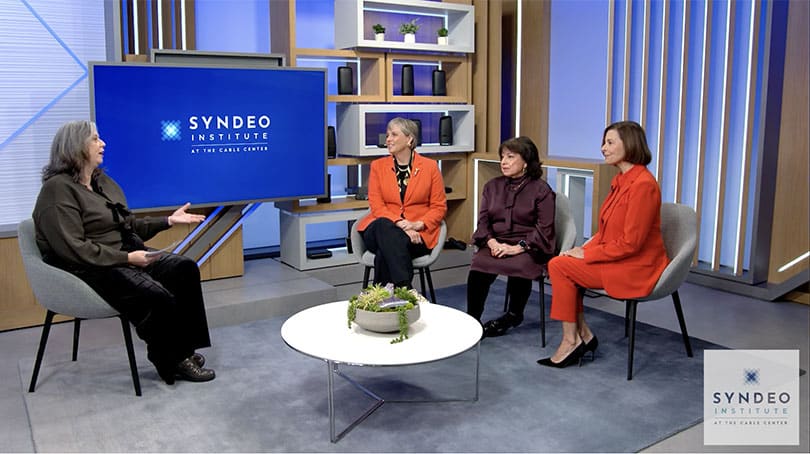
Interview Date: December 5, 2025
Moderator: Amy Maclean
Panelists: Janice Arouh, Italia Commisso Weinand, Sandra Howe
Series: Women In Cable Archive
Abstract
The December 5, 2025 “In the Trenches” panel at Charter’s Stamford studios—moderated by Cablefax’s Amy Maclean—brings together three veteran perspectives across the cable ecosystem: Janice Arouh (network distribution/programming), Italia Commisso Weinand (operator/service provider leadership at Mediacom), and Sandra Howe (technology supplier/board roles). They frame early cable as a “Wild West” that created unusually meritocratic openings: Arouh contrasts cable’s receptivity to women with the male-dominated broadcast world she considered before Showtime, Weinand recalls the youthful, get-it-done camaraderie of early NYC cable versus traditional retail, and Howe describes being trained into fiber-era cable technology and forced to “learn everything” by designing the networks she sold—an innovation cycle that kept generating new career runway (digital cable, high-speed data, etc.).
From there, the discussion pivots to how careers (and the business) survive constant reinvention: Weinand argues the key is staying focused, relentlessly curious, and learning from the past—illustrated by her “addressable cable” anecdote, where she spots churn behavior and proposes charging upgrade/downgrade fees to stabilize revenue, then generalizes that “what was old is new again” in today’s streaming dynamics. Arouh emphasizes values-led leadership—commitment, optimism, integrity, kindness—and treating failure as a learning engine, while Howe’s sailing metaphor (“adjust the sails”) becomes a practical change-management playbook for navigating technology, consumption shifts, and transactions without losing your “North Star.” The panel closes on relationship economics and professional craft: long-term trust and fairness in tough negotiations, “all boats rise with the rising tide,” and pragmatic guidance—Arouh’s “know the numbers”/take finance classes, Howe’s focus on connections, and Weinand’s insistence on building a reputation grounded in integrity and “speaking truth to power.”
Interview Transcript
AMY MACLEAN: Hi, I’m Amy Maclean, editorial director of Cablefax. And today is December 5th. We are at the Stamford studios of Charter Communications. And I’m with a wonderful panel of seasoned professional women who are here to talk a little bit about their careers for us. They have decades of experience. Why don’t we each take a moment to introduce ourselves and tell us a little bit about where you come from in the industry? Sandy.
SANDRA HOWE: So I’m Sandy Howe. I’m currently the independent director at ATX Networks on their board of directors. I come from several different technology companies including Scientific Atlanta, Cisco, Arris, Technetix. And now serving on several corporate boards
ITALIA COMMISSO WEINAND: Hi, I’m Italia Commisso Weinand. I run HR and programming for Mediacom Communications Corp. I’m a veteran of 48 years in this industry. Proud to say that. And I worked for let’s see, we’re at Charter headquarters, I’ve worked for Time Warner, I started my career at Time, Inc. Manhattan Cable. Worked at Comcast. And then joined my brother in his venture and created Mediacom.
JANICE AROUH: I’m Janice Arouh, president of network distribution at Allen Media Group. I’ve been in the industry for a little bit more than three decades and I love this industry and I’ve had the opportunity to work on many brands inclusive of Showtime Networks, the Hallmark Channel, Fox Cable Networks, as well as my current role working for Byron Allen’s Allen Media Group.
MACLEAN: Well, it’s wonderful to have the three of you here today for this discussion for the Syndeo Institute’s oral library. And I love that we have someone from technology, someone from content, someone from the service provider side. I think that’s really going to make for an interesting conversation. And one of the first questions I want to ask you is the cable industry, especially when you joined, it was very entrepreneurial. It was the Wild West. You were the disrupters. And I’m wondering as women did the industry have different opportunities that maybe some of the traditional sectors — Janice, I know you came from advertising. Or maybe finance. Were there more opportunities maybe for you as a woman?
AROUH: I believe there were more opportunities for me as a woman in the cable industry. When I decided to pivot from advertising to cable I was thinking for a moment about broadcasting. Broadcasting is a heavy male industry especially when I started. And I was so fortunate to have an opportunity to work at Showtime and it really opened up my eyes and realized very quickly that the industry was blossoming and it was very receptive of women, particularly for my role at that time which was an account executive in a sales role.
MACLEAN: Italia?
WEINAND: My original vision and my aspirations were in the retail business. Retail fashion design, buying. I kind of fell into the cable business in New York City. And the interesting part of that is that retail was older industry, traditional, et cetera. And I sort of fell in love with just the camaraderie. We were all young. Very young. There were not a lot of criticisms of how to do things because we all worked hard together. It has kind of sort of the family atmosphere, something that we re-created at Mediacom as far as I’m concerned, existed. And it wasn’t about even education. How educated you were. It was about really getting the job done. And being in a business that nobody knew what the heck we were doing. But oh my God, did we invent things that I still apply to this day. And culturally also, being owned by an incredible organization which was at that point Time, Inc. But the use part I think is what’s important. We worked hard and we played hard. But we got the job done.
HOWE: When I joined the cable industry I was very fortunate to have someone take a risk on me. And I entered in the technology space. I was a certified teacher. And I moved in beside the head of vice president of engineering for a fiber-optic company right when the cable industry was first deploying fiber optics. And from there they taught me the technology. And so I learned. And we were such a small company. I had to design the network that I then sold. So I had to be a sales engineer as well as salesperson. And I learned everything. From that where the industry kept giving is — because we were so innovative as Italia said, we kept innovating. So then the next thing we had was digital cable. And then high-speed data. And that innovation allowed me to keep learning and growing. And then that growth provided many opportunities to advance in the industry.
MACLEAN: Were there many other women in technology? Or were your mentors mainly male?
HOWE: I was very fortunate. There aren’t very many women in technology. All of you that know me know I want more women in technology. And so I didn’t have that many female mentors. But I had great male leaders that gave me opportunities. And that opportunity, I’ll never forget one of my first bosses at Scientific Atlanta Joe Quane said to me, “Go take care of Time Warner.” It was opening a big lab in Charlotte, North Carolina. I lived in North Carolina. He said, “Go take care of them. And I need you to cover something for me.” He said not only did I cover it, he said, “Any time I opened a door you just went in and kept learning and growing.” And I grew with our customers as they grew.
MACLEAN: That’s great. Well, that’s a really good point because today, by the way, we woke up to the news that Netflix is buying Warner Brothers Discovery which just a few years ago was what, AT&T Warner Brothers. There’s constant change. And you all have seen so much of it. How have these industry shifts forced you to reinvent yourself over the years?
WEINAND: Good question. It didn’t take that much, quite frankly. If you stay focused on the business and you flowed with the business, you just evolved and developed. Just know that I was at Manhattan Cable when Chuck Dolan, the late great Chuck Dolan from Cablevision, was knocking on hotel management doors to introduce HBO. So think about that for a second. HBO. That’s 40 some odd years ago. And here the acquisition of one of the biggest brands in the world is HBO. It’s evolved. I personally have a lot of heart about what was created at HBO. The incredible talent development. Money was spent but oh my God, look at what they built. And now it’s being sold for mega mega mega dollars once again. I just hope that the people that ultimately own it, develop it, remember what came before. Because it was greatness that came before. I’m not sure where it’s going to when — with all due respect it’s all about the bottom line. But talent has to be nurtured. I’m on the operating side. I’m not on the creative side. But I understand creativity. I come from a culture of creative people. And I appreciate it. I appreciate what that gentleman behind that camera does. Because a machine cannot do that. And not letting go of what the business foundation is, which is to serve communities, and to enrich our lives with ideas, thoughts. Pushing people to the edge to do more and better comes from the entertainment business. I just hope that it’s preserved and it’s cherished and there’s more of it. Not just a business transaction. It doesn’t matter who owns it. The stewards of who own it should remember the past. Because you can’t go forward without understanding what was.
MACLEAN: But you’ve gone forward. You’ve remembered the past and you’ve adapted. So do you have a piece of advice for someone maybe who’s just starting?
WEINAND: No, just work hard. And I hire people a lot today. What I feel strongly about is that I don’t see a lot of curiosity about what you do. My if you want to call it success was I never stopped learning. I never thought I knew it all. For me it was about curiosity. Okay. How do you do this? How do you do this and how do you do it better? Because I always took the next step. The industry catapults you into doing better because you have to. We have lots of challenges today. Different from the past. I don’t fear it. I don’t know if I have the energy because I’m getting old. I don’t know if I have the energy. But I’m never going to stop asking the question. To your point. The challenges that we have are huge. But do you give up? Not me. But it’s work. It is work.
MACLEAN: Janice, what about your thoughts?
AROUH: I wake up every morning looking at life through rose-colored glasses.
WEINAND: She does.
AROUH: I do. So for me it’s commitment. It’s optimism. It’s integrity and kindness. And those are four key traits and ingredients that I would like to encourage all to embrace. And that leads to the answer to your question, which is change. It’s important to make pivots in our careers. I’ve seen Sandy do it. Italia does it extraordinarily well. As well as you, Amy. And it’s about embracing change and realizing that’s the new path. And you’ll be successful. Will you fail? Absolutely. Have I failed? Absolutely. But those have been some of my most important learning moments.
HOWE: It’s very interesting. For those of you that know me know I live on the coast of North Carolina. My cable career took me there. And I had the opportunity to love the ocean, and with it my favorite quote reminds me of what this industry is all about. A pessimist expects the wind not to change. An optimist things the wind will change. But a realist adjusts the sails. And I have been through three successful transactions of large companies, growing them from when they’re small to large that have sold. I’ve also done many transactions while at those companies. And it’s all about changing. And it holds very true to what Janice said. Hold your values. And Italia. Hold the values that are dear. It’s about knowing what your North Star is. But in sailing you can’t always go in a straight line to get there. And you’ve got to change. You’ve got to adapt. And that is exactly, too, what’s going on in business today. We have to as the way people consume content is changing and as we have all these high-speed networks to deliver that content, we’ve got to continue to adapt as our consumers are adapting, as the technology allows us, and to keep adjusting our sails.
MACLEAN: That’s great advice. And I’m going to remember my North Star because it just feels like every day there’s a new wave hitting me. [laughter] One of the things I’ve enjoyed. We’ve spent time together before this panel. And you all are obviously friends. You’ve known each other for years. And I think that’s true for so many people, especially women, in this industry. I’m wondering how you’re able to balance that collegial nature when sometimes you’re navigating some pretty tough business objectives and you’re not always on the same side of the table.
WEINAND: That’s for sure. Janice said it well. Integrity, self-regard, self-respect of others. Those are tandems that hopefully our parents gave us. And build us to be strong people. And then go out into the world and really test them. Somebody once said to me that they’re really not yours until you’re tested and you come out on the other side with that. And if there is– what I give myself credit for is that I’ve been tested many times. And I’m still who I was with those values, those expectations of myself. And you know what’s interesting I find is when you treat people right with regard, with respect, and with fairness, eventually, no matter who you’re dealing with, it’s infectious. Just like the bad stuff is infectious, the good stuff is infectious too. So I don’t need to have any more friends. I love having respectful regard in friends because we come from that, from a similar expectation in life. And I don’t care who you are, where you’ve been, where you come from, if you can bring that out in people, you’re doing pretty good. And that’s part, I think, what the camaraderie is in our industry. Whether it’s women or men. We got it at a very young age I think. And the ones who have survived the challenges I believe are the ones who stayed true to that. Not just to yourself, to that within the people that you socialize and have expectations with. And it’s a formula. It’s worked for me. But it’s not easy. It is not easy to stay true and to stay honest. My mother used to say to us. She was great. Getting into our heads. “Do not lie, because liars have to have a good memory. And you don’t have a good memory.” [laughter] I grew up thinking I can’t remember anything. And she was right at the end of the day because when you steep yourself in lies after a while you don’t know what the truth is. You don’t know what the reality is. And so those are simple truths. Simple wisdom of people who came before us. Just like I said. Respect what came before. Understand what came before. If you want to catapult it. Because you know what’s interesting is I personally find many a time when I don’t know which way to go, remembering the past gives me the answer for the future. That’s just kind of a self-discovery.
HOWE: And I think so much goes back to my mother always taught me treat people the way you want to be treated. And in our industry it’s always been working together. We’ve had to work with the content providers, the operators, and you need the technology to enable it. And I will tell you there’s not a single new technology — and I’ve launched a lot of them over the years — that’s worked right away. We have reboots. We have major outages. And I always believe it’s how you work through those times of challenge when things aren’t working and it’s figuring out again putting that team together. And that’s what my customers have known me to do, is I work to put the team together to solve it. And we got it going. We did so many different types of — as the networks evolved from digital to we’ve added broadband to time-shifted TV, streaming, and now we have AI coming into everything — we just keep working together. And it is holding true. Treating people the right way. Getting things done, that will help. And working together. But you earn your stripes when things aren’t working. That’s when probably some of my strongest, although I thought I was going to never make it, moments.
AROUH: I would say that it’s building long-term trusting relationships that’s always been really important to me. Italia and I have known each other for 25 years. Italia and I have had some really difficult negotiations. Whether it was network increases or a retransmission deal. One thing that was always important to me was to listen to every word Italia said. Were we on the phone for two hours? You betcha. Did I say very much during those two hours? No. [laughter]
WEINAND: My brother’s adage in life was if you can’t convince them, confuse them. “What was my question?” [laughter]
AROUH: That’s right. Italia is absolutely right. You have to absolutely embrace your relationships with your clients, with your friends, your colleagues. Because it’s so important to be trusting. To be truthful as Italia says. No need to lie. I know for me personally I can’t lie because I will not remember. You know me. I will leave my purse somewhere and not know where it is. So I can’t lie. But the industry is absolutely collegial. We have again difficult negotiations but at the end of the day we all take a deep breath and celebrate.
HOWE: And to close out on this topic the one thing I think that really makes us unique and that we know from working together, it’s that all boats rise with the rising tide. And we have always figured out how to work together. And grow. And look at all the innovation that we’ve done. The only reason we have streaming today is because of high-speed broadband.
AROUH: That’s absolutely true. Streaming wouldn’t be here today if it weren’t for the pioneers of our industry.
WEINAND: But just know we invented streaming via pay-per-view a long time ago. So we won’t go there.
MACLEAN: And the two-way interactive cable modem. All of them. And the two-way interactive cable modem, all of those.
WEINAND: It was there. I tell people these days. This is sometimes my ego overworking time. I remember going to Chicago in a fully addressable system in the ’80s. At which point I walked in. There was HBO, Showtime, and Disney was about to launch as a pay service. All the folks would come because Chicago was a great marketing kind of study place. And the numbers weren’t there. So one day finally I went to run customer service. I sat on the phone because I didn’t understand what was going on. Because pay-per-view — excuse me. Addressability was so new in our business. And no one understood it. So I find out what was happening. People would call up and watch Showtime for two weeks and because we had cycle billing at that time it didn’t even hit the bill. And hit disconnect. Because all it took was a phone call. No truck rolls. So two weeks they’d have Showtime and two weeks they’d have HBO. And they would go run. Not because they were trying to cheat the system. They just thought they could do it because there was no barriers to doing that. So I went to the folks who owned the system at that point. I said, “You’re making some big mistakes.” And they said, “Well, what do you think?” I said, “At this point it costs us money to roll a truck. Now it costs us less but you’re still paying for a customer service rep to do that functionality. I think you should charge for an upgrade and you should charge for a downgrade.” Guess what, we started making money for upgrade and downgrade. HBO got paid and Showtime got paid. And suddenly the numbers popped. And I said to somebody, “I wish I could have helped all the streamers because I would have told them the people connect and just churn.” It’s called churn. Disconnect.
MACLEAN: Was it hard for you to step up and make that suggestion and feel like your voice was heard?
WEINAND: No. Not at all. Because it was like I would have HBO, Showtime come and romance my customer service reps with lobster parties. I used to tell Showtime, I said, “Hey, when HBO comes in they buy my reps a lobster. You give them shrimp, but maybe you should, you’d sell more.” And they didn’t understand what was going on. Because it was so new. It was 1983. And no, they would not because it’s like what’s going on. And just think about that. I said, “How did the big boys, all those folks in all these big seats didn’t figure out that people are going to disconnect and reconnect as they watch.” What’s it called, eating everything all at once. Look at how over the top has transitioned. Now they give you pieces every week, so you keep coming back. I could have told them that 10 years ago.
AROUH: So you’re saying what was old is new again.
WEINAND: That’s my point. That’s been my point. Respect the past. Go and figure out what happened. Figure out why pay-per-view didn’t work in our business. Just think about pay-per-view. It’s over the top to some degree. Why didn’t it work? You know why pay-per-view didn’t work? Not technology, that was not the problem.
MACLEAN: Was it the customer experience? Calling in and doing –
WEINAND: No, it’s cost. Remember in those days we had videotapes.
MACLEAN: Twenty bucks for –
WEINAND: No, it was $4.95 and I used to call the program guy at Comcast say –
MACLEAN: For the big fights though you had to pay a little more.
WEINAND: The big fights. My God, we killed it. You’re talking about a 30 percent buy rate. And the fights were like $49, this is when Tyson was the star, $49.95 in one night. I couldn’t believe the money we made, that I made for the companies I worked for. In one night. Because people would come and pick up the box so they can have the addressable box to watch the fight. But the movies didn’t kick in because you had DVRs. You had the video stores. We had lots of competition. But –
AROUH: Plus during the day.
WEINAND: If I can pitch our industry a little bit, the studios were a little greedy, they refused, because I would call corporate Comcast and say, “Can we figure out how to drop the price?” $4.95 for a movie was a lot of money in 1990. It was. I said, “I bet you I can double the revenue at $2.95.” Nobody listened. They agreed with me but they couldn’t get it done because the studios dictated price at the end of the day.
MACLEAN: And then COVID happened and all the theatrical windows collapsed and funny how things change.
WEINAND: Finally. But you’re talking what, 20 years, 20 some odd years later.
MACLEAN: Yeah. I think before we close here today I want you to think about when you boil it all down what’s the single guiding force that has had the biggest impact on your career. Janice?
AROUH: The single guiding force that’s had the most impact on my career is working for people that believed in me. That was my fuel. And the respect that I have received from so many leaders that I’ve worked for over the years was really important. And the accomplishments that allowed me to recharge my batteries. To jump into other opportunities. Other projects. Building businesses. And learning from my mistakes enabled me to grow even more so. One tidbit that I want to share with women in particular. And this was another guiding force for me, was know the numbers. Take finance classes. If you know the numbers you’ll be able to solve so many problems. If you don’t know the numbers it’s going to be difficult for you to make really smart decisions. So that is another guiding force. I encourage everyone to take a finance class.
MACLEAN: It’s so funny just talking to you today the number of times you’ve mentioned numbers and finances just in conversations we’ve had. I see that in everything you do.
AROUH: Very important. Very important.
MACLEAN: Sandy?
HOWE: So when I think about the impact in the industry I’ve been fortunate. It’s been all about connections. And I’ve been fortunate to work for great companies and I still get to work with great companies like ATX Networks connecting the subscribers, building these networks that have connected us, that are providing us with this full convergence that we’re seeing in the network for the first time ever, that we’ve talked about since I’ve been in the industry. And it’s also about the connections of people. These networks connect us. They make it easier for us to all stay in touch. It makes it easier. So many things with social media has evolved. You have email. And everyone knows I’m still about a handwritten note. I do my fair share of those. But it’s about those connections and keeping those connections. And so we have to keep the networks running. And also maintain all the relationships that we have. And you want to, because we’re all friends.
WEINAND: Well said. Well said, Janice. I think that there’s probably three things that if there’s advice to be had. Listen to the negative and listen to the positive. I’ve had very fortunate opportunities because people really believed in me. I did not believe in myself. But given how I was catapulted in very large jobs with a lot of responsibility and supported, it’s like wow, I guess they selected me because they believe in me. And what are the qualities that I brought to the job that supported whoever believed in me. Because I never wanted to disappoint anyone. And building a reputation separate from all the folks who influence you that sustains you. Because in the end I look back and I realize the kind of respect I have in the business. How many people I touched. But I treated them right. They treated me well. But I treated them super right. Above and beyond the call of duty. So in the end when it came time to build our own little company I looked back and realized. I said, “I have a reputation I didn’t know I had.” Which is integrity. Speaking truth to power. If that’s the thing. Without fear. And staying true to myself. And that’s hard to come by. Hard to accomplish. But you can do it. Because it’s that simple. But what the industry already had which is this whole built-in family attitude. We all took care of each other. The competition. It was different. It was wonderful. It is the industry that I fell in love with. And the people in it that made up. Which is so unique. I don’t think there’s anybody in Silicon Valley that built an industry, they built an industry, but I don’t think there’s this kind of camaraderie that we’ve had in our business and I hope to God that we don’t forget.
MACLEAN: Well, this has been wonderful. Thank you so much for your time. I’ve learned a lot today. Thank you for joining us. And that’s it for our panel.
WEINAND: Thank you, Amy. Well done, Amy, well done.