

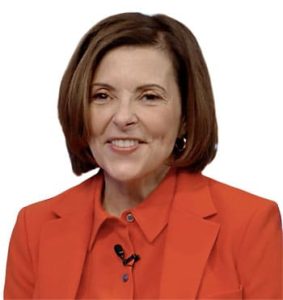
Interview Date: December 5, 2025
Interviewer: Stewart Schley
Series: Women In Cable Archive
Abstract
Janice Arouh, President, Network Distribution, Allen Media Group, recounts coming into the cable industry in the early 1990s and landing at Fox Basic Cable as affiliate sales helped turn the network into “fX.” She describes how the 1992 retransmission-consent regime created leverage for Rupert Murdoch’s broadcast-station group, and how a “quid pro quo” with John Malone’s TCI—carriage of the new channel instead of cash fees—became the spark for fX’s massive launch. fX went live June 1, 1994 and, via TCI systems, debuted to roughly 17 million subscribers. Arouh’s role as Director of Affiliate Sales was then to expand carriage system-by-system, selling operators on both the distribution logic and the promise of distinctive daily programming.
She then explains her pivot to Crown Media/Hallmark, joining when Hallmark had about 35 million subscribers and setting a clear objective—reach roughly 90 million TV households—supported by a distribution strategy that targeted every state capitol and leveraged the network’s family-friendly positioning with political outreach. From there, Arouh details her later work with Byron Allen and Allen Media Group, emphasizing modern distribution mechanics: scaling AVOD/FAST via Local Now (hundreds of FAST channels plus ZIP-code-level “hyperlocal” news, weather, traffic, and sports) and using The Weather Channel’s fully distributed footprint—acquired in 2018—as a platform to strengthen broader carriage conversations across the portfolio.
Interview Transcript
STEWART SCHLEY: Greetings. And again, thank you for hitting Press-Play on this iteration of the Hauser Oral History Series presented by Syndeo Institute. In the early to mid-1990s, a couple of thunderous things happened in the television and media ecosystem that continue to ripple across that ecosystem today. I would tell you about it, but why me? I’m going to instead turn it over to today’s guest, Janice Arouh, who was at the center of the storm in a lot of ways, and continues to be an influential force in a shifting media picture. Janice, thank you for being with us.
JANICE AROUH: My pleasure, Stewart.
SCHLEY: Now I’m springing that on Janice. We didn’t actually rehearse this, but immediately, can you take us back to 1993, 1994, when you joined a company called Fox to do something. Remind me of that time.
AROUH: That was a wonderful time in my career. I joined the Fox Basic Cable Network and Fox Basic Cable became fX and its president at the time was Anne Sweeney. And we went into the market, we went to the MSOs, multi-system operators, and said, “We have TV made fresh daily for you.” And that was the premise of fX. It was a lower-case f, X being the klieg lights. And so sometimes I would say to Anne, I’m like, “How are we going to sell this?” She said, “It’s easy, Janice. F is lower case, so it’s friendly. The klieg lights from Fox. You can get this done.” (laughs)
SCHLEY: I did not know that.
AROUH: Just like that. So we did that.
SCHLEY: Okay. Okay. fX was one of — maybe the — signature poster child for this renaissance in a rejuvenated cable programming period. And when I mentioned there were thunderous developments that occurred, I think of fX as one of the networks that took advantage of some shifts in television, one of which was related to a 1992 federal law that codified something called retransmission consent.
AROUH: Oh, don’t say that too loud. It’s the most unliked word in the industry. (laughs)
SCHLEY: It is. I know. And let’s just call it the R word for now, but that’s — it’s a great point. Is it possible to tell us what retransmission consent was and why it mattered when you guys launched fX?
AROUH: Well, there’s some history there.
SCHLEY: Okay. That’s why we’re here.
AROUH: Let’s rewind. Back in the day, Mr. Murdoch owned a few stations, the Multimedia Group, and then it was in 1991, 1992, when he spent five billion dollars to buy the Chris-Craft stations.
SCHLEY: These are over the air television stations?
AROUH: Yes. And so he had a collection of many broadcast stations. Most were in NFL markets, Cleveland, Dallas, Los Angeles, among others. So he said, “I have these football markets. I have football on my stations. The cable operators are retransmissioning my networks. I’m not getting a penny. I need to pay for these Chris-Craft stations that I paid five billion dollars for.” Right? So he said, “I am going to get the cable operators to pay me 25 cents per subscriber to carry my television stations.”
SCHLEY: For the right to carry my television programs.
AROUH: That’s exactly right.
SCHLEY: Okay.
AROUH: So, fast forward, he then went to Dr. Malone, John Malone, and he and John came up with a point of view, “Well let there be a quid pro quo. I’ll give you carriage for fX in lieu of you asking me to pay you 25 cents per subscriber.” So that was the spark of fX. fX was the largest cable launch in history at the time. We launched across those TCI systems, 17 million subscribers.
SCHLEY: It was brilliant, I think, because I think the idea of retrans was just what you articulated. “I have these TV stations, you’re distributing them to your cable subscribers, pay me some money.” Instead of paying money, the quid pro quo was, “How about if you make room on your system for a new television channel?”
AROUH: That’s right.
SCHLEY: And you’re saying it was the largest day-one launch in cable —
AROUH: History. In history, yeah.
SCHLEY: Yeah. I dropped you right into that, but I think it’s a key story.
AROUH: June 1st, 1994.
SCHLEY: June 1st, 1994. What was your job and job title then? What were you hired to do?
AROUH: I came in as Director of Affiliate Sales, and so my responsibility was to go out in those days to all the local cable systems. Then, cable systems decisions were decentralized. Now, those programming decisions are centralized, coming from their corporate headquarters, whether it’s coming from here in Stanford, Connecticut, from Charter or in Philadelphia from Comcast. So it was really a wonderful foundation for my career to go to Cox San Diego, Cox Santa Barbara, Cencom in Riverside, Comcast out in Inland Valley, and tell them all the reasons why they needed to launch fX. And we did it sub by sub.
SCHLEY: What was the reception in general from these cable — you’re knocking on the doors of pretty large metropolitan area cable systems, and they get hit up all the time by people who want to have their channels carried. What was the sell for FX beyond the big retrans deal that you had at the TCI level?
AROUH: Sure. It was the value proposition bringing not only original shows, right, to the TV screen. It was, as I mentioned, it was Tom Bergeron in the Morning Show, and then we had the antique show.
SCHLEY: That’s right.
AROUH: So it was unique content at that time, and a lot of content from Fox.
SCHLEY: And when I mentioned the thunderous developments, we talked about retrans. We were also on the cusp of retooling the technical infrastructure of the cable industry to make room for more channels. We call it the digital conversion or the digital transformation. Did that play a role in at least opening up the doors for what you guys did?
AROUH: It certainly did. Later that year on Halloween, October 31st, we launched at FXM, Fox movies, and those were all the terrific movies from the Fox Library, and we were able to get that one up and going. And it was a few years later, Dr. Malone and Mr. Murdoch came together, and it was the next evolution, the next pivot point for Fox Basic Cable entering into the sports arena. So the regional sports business came alive at that point in time. Dr. Malone had five regional sports networks, whether it was Fox Sports West in LA, Fox Sports Pittsburgh, among others. And then fast forward, when I finally left Fox to go to this wonderful brand named Hallmark, we had 22 cable networks in the portfolio. The last two networks that we launched while I was there was National Geographic Channel.
SCHLEY: Oh, that’s right.
AROUH: And National Geographic Wild.
SCHLEY: Twenty-two.
AROUH: Yes.
SCHLEY: So you sort of came from almost ground zero to a pretty prolific program offer.
AROUH: And I love that.
SCHLEY: You loved it.
AROUH: I love it. I love building. I’ve never taken a job where the network was fully distributed. I love building.
SCHLEY: Where did you start in terms of understanding the cable industry at large? And all of its Byzantine structural qualities.
AROUH: It was my very first role at Showtime Networks.
SCHLEY: Showtime.
AROUH: And I started out there working for Dotty Ewing. Dotty Ewing, hiring me at Showtime, changed my career trajectory. I do not believe I would be sitting with you here today still.
SCHLEY: I totally believe you.
AROUH: And I decided I would take that job coming out of advertising, and I knew that it would be the right fit for me because in advertising, you’re doing a lot of listening. Listening to the client. And in this case, I went from brand management into sales, still listening to the client, right? Understanding the client’s needs, understanding their objectives and I sold them Showtime. And again, I was traveling to Big Bear to meet with Stubby and Peggy Ent, a Marc Nathanson system when he owned Falcon.
SCHLEY: Falcon.
AROUH: And they launched fX. Going out to Inland Valley and meeting with, in that day, Dave Barford, and they launched fX. So that is how we got the distribution — system by system. And it was establishing those relationships with Jim Petro, Jim Mattisock. They too were the Copley-Colony guys. And it was really interesting because many of them did say no. And the no was always, “Well, we don’t have any bandwidth.”
SCHLEY: Exactly. No channels available, right?
AROUH: And then slowly but surely, they increased the bandwidth and there was more opportunity, and we got more launches for fX, for Fox Movie Channel, and those relationships to this day are really important to me.
SCHLEY: What was the appeal of the Showtime job? Besides Dotty Ewing being a promising —
AROUH: Golf tournaments. (laughs)
SCHLEY: Okay. Say no more. Okay. No, but I think from what I’ve read, you really did want to work in the advertising agency environment, and you did. And so you left that for this premium television gig. What was — why?
AROUH: I felt that this was a growth area, and I thought it would be just exciting. I love people. I love connecting with people, and I felt that was my sweet spot.
SCHLEY: Do you remember the very first cable system you called on?
AROUH: I sure do.
SCHLEY: What was it?
AROUH: It was Cencom out in Riverside. And the gentleman —
SCHLEY: And you’re this fresh faced —
AROUH: Right, I’m just driving all over town. My husband was born in Los Angeles too, and he to this day says to me, “How do you know about that street? How did you know we needed to make a left there or a right there?” And it is because I went to that Century Cable system in West Hollywood at the corner of Santa Monica and Robertson.
SCHLEY: It’s imprinted on your brain.
AROUH: Point. It still is. It still is.
SCHLEY: You mentioned this is the early 1990s. With Showtime it was around 1991, 1992, I think.
AROUH: Yeah, that’s exactly right.
SCHLEY: Could you sort of feel the energy, the cable energy, if you will? You knew you were into something that was going to be a happening thing?
AROUH: Yes. Yes, absolutely. The energy level was at a hundred feet. It was just so exciting, and we were building together. We were collegial, and all we needed to do is get more subscribers and ring the bell. We were so excited.
SCHLEY: Was there literally a bell?
AROUH: There was. There was.
SCHLEY: A virtual bell?
AROUH: There was. At Showtime. Yes, there was. Carol Mechanic had a bell in her office, and if one of us got a deal done, ding, ding, ding. Very Pavlovian. (laughs)
SCHLEY: Janice, what was — it worked. It works. Good. Reward system. When you were a kid growing up, I think in the Cleveland area.
AROUH: Cleveland.
SCHLEY: What was television like for you?
AROUH: I didn’t know any better. And back then, and you’re way too young, so you probably don’t remember this. There were three VHFs, right? ABC, NBC, CBS.
SCHLEY: Did you even have a remote controller? Did you have to stand up and turn the dial?
AROUH: We had the old console television, right? I heard each click.
SCHLEY: Right, right. Oh my God. I remember.
AROUH: And some of my favorite shows when I was a young woman were Bewitched, and that’s how I actually got into advertising. I wanted to be like Darrin. I wanted to be like Darrin.
SCHLEY: Because Darrin was an ad guy. The husband of Samantha.
AROUH: Yes. I didn’t want to be Elizabeth Montgomery or Samantha. I wanted to be just like Darrin. I wanted to —
SCHLEY: So that’s interesting.
AROUH: That’s how I started.
SCHLEY: I think your first job in media though, had to do with the newspaper business when you were in eighth grade or so.
AROUH: Eighth grade. Eighth grade.
SCHLEY: Do tell.
AROUH: Oh, how do you know all this?
SCHLEY: I’m a sponge.
AROUH: Yes. I started out selling the Cleveland Press and delivering newspapers.
SCHLEY: Door to door.
AROUH: Door to door. Back then the newspaper was 60 cents a week. Everyone gave me a buck, so I made 40 cents on every single house, and I thought that was a big deal, and I loved it. I had a punch card.
SCHLEY: It’s classic. I guess what I’m getting at is with Darrin, what was their last name? Samantha — began with an M, I think. [Stephens]
AROUH: I don’t remember.
SCHLEY: All right. Darrin, the fictional ad guy, the Cleveland Press distributing newspapers. You kind of had media in your DNA a little bit. Do you think so?
AROUH: I certainly did. I did. I did, because I had this desire after watching the show that I was going to go into advertising. Those ads were in the newspapers. Those ads were in publications, right? It was all print back then.
SCHLEY: What made you a good sales representative for Showtime and then later the Fox family of networks?
AROUH: I was a terrific listener, and I still am. And I always wanted to know before going into a meeting what the client’s objectives were. What did they want to accomplish in six months? What did they want to accomplish in the next 12 months, and how were the products that I represented going to meet their needs? What value did the products that I sold them have? How were they going to enable them to acquire new subscribers?
SCHLEY: Yep.
AROUH: Reduce churn.
SCHLEY: These were the business ambitions of these companies.
AROUH: That’s exactly right.
SCHLEY: Right. It was anything for you other than the glad handing salesperson?
AROUH: Yeah, I did have some premiums with me all the time.
SCHLEY: In your time at Fox, what was maybe most rewarding about that odyssey,
that journey?
AROUH: It was always a challenge, and it enabled me to take risks, do things that I’ve never done before. And what does that mean? When I was at Showtime, selling Showtime in the movie channels with premium service, it was a single revenue source service subscription revenue only.
SCHLEY: I might’ve paid seven or eight dollars for my subscription, right? Was that about the price point for Showtime?
AROUH: Yeah. Okay. Yeah, that’s exactly right. And it grew to $10 and so on, and then I decided I was going to go to Fox Basic Cable, and that was an ad — two revenue streams, ad sales, as well as affiliate sales.
SCHLEY: Right.
AROUH: And I wanted to understand that business model.
SCHLEY: Janice, when you segued from Showtime, the job at Showtime, which was a single premium channel that you sold into the cable industry, to Fox, which was the force behind what we call a basic cable network, what was the learning curve there and why was it of interest to you?
AROUH: It was of interest me because, to your point, the premium business was a single revenue business. It was subscription based. On the other hand, basic cable had a dual revenue source: subscription as well as revenue, ad sales revenue. So I was interested in knowing about local advertising, and so it was those two minutes of local avails that added a new dimension to my areas of responsibility.
SCHLEY: The model was such that you sort of gave some advertising time to your affiliate distributors and they could do with it what they wanted, right?
AROUH: They could sell it to the local mom and pop in the community.
SCHLEY: The bike store.
AROUH: The bike store, the local restaurant.
SCHLEY: And that was helpful in terms of making the argument that, you just said it earlier, you were going to advance the business of your customer.
AROUH: That’s right.
SCHLEY: Your customer.
AROUH: That was one value proposition.
SCHLEY: I want to do one more of my trio of thunderous moments. We had retransmission consent come into play. We had this digital conversion for cable that expanded channel capacity, and then up in the sky there was this new mode of distributing television channels. In 1994, DirecTV launched. After a few failed efforts to do satellite television, they sort of figured it out.
AROUH: They sure did.
SCHLEY: What did that mean from an affiliate sales standpoint for you guys at Fox?
AROUH: Well, the writing was on the wall. It meant more distribution, more revenue, but it also presented some challenges. There were some of the MSOs, multiple system operators, who did not want us to call on them. They wanted any affiliate sales person that may be on the DirecTV account to recuse themselves from either working on the DirecTV business or to discontinue servicing their business. They wanted to keep things in a silo.
SCHLEY: They, I think, sort of considered cable networks to be their networks. And now here’s this new interloper coming, raining down my same television signals from above.
AROUH: Taking — the threat — taking my subs away,
SCHLEY: Taking my subs away. But from a programmer standpoint, it was all good.
AROUH: It was upside. Yeah, it was upside.
SCHLEY: You have national distribution and a new player in the market, so it was a busy time. It was an active time, and you guys obviously did really well in that environment. I think FX quickly became one of the signature crown jewels of the cable business.
AROUH: Oh, absolutely.
SCHLEY: You worked in that organization for how long?
AROUH: In various roles in different divisions, 10 years.
SCHLEY: Okay. And did your role change or was it always sort of focused on —
AROUH: The majority —
SCHLEY: — distribution of networks and keeping affiliates happy?
AROUH: Yes. Distribution and affiliate marketing.
SCHLEY: Yeah. What was fun about it?
AROUH: The challenge of getting the distribution. I love distribution.
SCHLEY: You are really motivated by that?
AROUH: Yes, I was. I just loved the people.
SCHLEY: Yeah. You loved ringing the bell or the version of the bell?
AROUH: Absolutely loved getting the distribution. I love the people. I really love the people, and that’s why I still have these long lasting, trusted relationships. They gave me an opportunity to be where I am today in this seat.
SCHLEY: You described yourself to me as a shy person.
AROUH: I am very shy.
SCHLEY: Does being shy — did being shy have its upside at all in terms of believability or credibility? What do you think?
AROUH: Yes, it did. It did because being on the shyer side, I have an absolute desire to listen, and so that focus really enabled me to tap into the challenges of our operators. I also became many of their psychologists. (laughs)
SCHLEY: Why does this not surprise me? Okay. Your customer base cable operators, mostly menfolk, or how did it sometimes feel to be the person in the room who looked a little different from a lot of the other people in the room? Just from a gender standpoint?
AROUH: It was my advantage. It was absolutely my advantage. My affiliate base, my colleagues —
SCHLEY: Your peeps.
AROUH: Yeah. They trusted me. They trusted me because I always delivered on what they wanted. I was believable. They knew I was committed. I was always optimistic. Even though when they said no. There are times I had taken 1500 noes and finally turned them into a yes. Can you imagine that?
SCHLEY: No.
AROUH: It’s not for everyone, right? Not for the faint of heart.
SCHLEY: The actual, when you got to a point of agreement that a large metro cable system is going to carry my channel, hooray. Ring the bell. What were those agreements? What was sort of the contract juice that made those things happen? Was it complex? Did they vary by customer?
AROUH: The deals did vary by customer. The deals were complicated. They are much more complicated today than they were in the 1990s or the Aughts. As soon as 2008, 2009, 2010, they became extraordinarily complicated. And now the terms around rights are, and digital management, very, very complex.
SCHLEY: Then we have new avenues of delivery.
AROUH: Absolutely. Absolutely.
SCHLEY: For those who are uninitiated, can you talk about, in general terms, what tended to happen if you had a butting of the heads or an agreement that came up for renewal and there was this dance that would occur where the cable company would say, “Sorry, we have to take this network off because they’re not being nice to us.” And the network would say, “We really want to be available in your household, but the cable company won’t be nice to us.” What were these standoffs like? Tense?
AROUH: Oh, they were so tense. They were so tense. I remember in the early days, going again back to Fox, because we really introduced and created the playbook for going off the air. (laughs) We had, this is when Fox-Liberty came together and we had sports. Mr. Murdoch had just acquired baseball rights. And so there were times when there was an overflow of games. So the MLB regional team, whether it was the Dodgers in one instance, or it could have been the Cleveland Indians. When we had sometimes games where we had a few more games than otherwise on the national feed, then we would open up a signal on a secondary feed, by example in the Cox Phoenix market.
SCHLEY: I didn’t know that.
AROUH: So what would happen is we literally would say, “We’ll give you that game, but you have to launch fX. We’ll give you that game, or you have to in order to launch Fox Movie channel.”
SCHLEY: Right. And Janice, how did consumers react? Did they tend to favor the side of the network in these impasses or ?
AROUH: In those days they favored the network.
SCHLEY: They did.
AROUH: They did, because sports was everything, and it still is everything. Today, sports is even more, it means more to them. You cannot take the sports away from them.
SCHLEY: No, no. Don’t take our precious sports away. It always felt like the dance was always the same. So how long would these disagreements last typically?
AROUH: It depended. They could have lasted from a day, and in some instances they lasted two weeks.
SCHLEY: Pain though, it’s painful.
AROUH: Yes.
SCHLEY: So tension does arise from time to time in any business relationship. I think I read you quoted one time saying tension can be a door opener though. Like you talked about hearing no a lot. How do you avoid just throwing your hands up in the air and saying, this ain’t going to work, and keep a positive pursuit of the yes in these deals.
AROUH: You have to stay optimistic.
SCHLEY: Okay.
AROUH: Optimism prevails at the end of the day, and I’m highly optimistic that a deal will be struck, and I have some deals that I’m working on now. I know they will get done. It’s just a matter of how do you architect the deal and how do you make it a win-win for the cable operator, the telco, the satellite companies.
SCHLEY: And my suspicion is you never wanted it just to be about price, just about license fee. That was an element, right?
AROUH: Yes.
SCHLEY: But there were other buttons you guys could push to be appealing, right?
AROUH: That’s right.
SCHLEY: Such as?
AROUH: That would be your content, right? Having some of the best original content, content that was highly viewed, brands that people truly enjoy.
SCHLEY: Revered.
AROUH: And revered, absolutely. Brands that they trusted like The Weather Channel, that we own. It’s the most trusted news brand in America for 13, 14 years.
SCHLEY: We will segue to your current role with Allen Media Group, but you took a pivot or a chance by leaving Fox and joining a company called Crown Media, which was prepping to launch a channel that was going to be called the Hallmark Channel.
AROUH: That’s right.
SCHLEY: Do I have that progression in order? Tell us about that.
AROUH: I scratch my head and say, “Why did I do that?” It was the next best move I could ever have done. Again, it was one of those pivotal moments. At that point, Hallmark had 35 million subscribers and they had a long runway in front of them. So I said to myself, “I’m going to get them along with my team into 90 million cable television households.”
SCHLEY: I was going to say 35 million was not nothing. That was a pretty good start.
AROUH: That’s right.
SCHLEY: I think at the time we had, just for context, maybe a hundred, 110 million TV households in the nation.
AROUH: That’s correct.
SCHLEY: You wanted to get to all of them basically.
AROUH: You betcha. And we did. We did, and we wanted to make sure — we had a strategy. We had a game plan. We figured if we got into every state capitol, right, if we reached out to the government in every state capitol, to the governor, to the senators, to the congressmen, congresswomen —
SCHLEY: Wow.
AROUH: — that would help us achieve our goal. Because it was the American brand.
SCHLEY: Absolutely.
AROUH: It was family friendly, and that was at a point where Washington, DC wanted family friendly content on the lineup. It was an imperative. It was almost a dictate from the FCC. So we tapped into that zeitgeist.
SCHLEY: Are you saying you wanted to be carried by the cable system that served the capital city of a state, or are you saying it was just total political outreach or both?
AROUH: It was both. Because our strategy is we want to be in every state capital in the country, and in order to do that, we reached out to the politicians and reaching to the politicians, there’s some overlap, and it was very contagious. So we were able to get distribution into the smaller communities outside of Columbus, outside of Cleveland. So we were able to secure Youngstown.
SCHLEY: Okay. Did it work?
AROUH: Yes.
SCHLEY: Okay.
AROUH: Yes.
SCHLEY: You got to your 90 million.
AROUH: We did. We did.
SCHLEY: Did — inside baseball so you decide, but was there a license fee attached with Hallmark Channel at that time?
AROUH: Yes. Yes.
SCHLEY: Okay. Because you had to have that dual revenue stream and probably the economics were such that subscription license payments were larger than the advertising sales revenue for that channel.
AROUH: In those days it was 60/40, 60 ad sales, 40 affiliate revenue.
SCHLEY: Okay. Same question. What was satisfying about that experience with Crown and growing that subscriber base, and other things too? What else did you do?
AROUH: People. The people at Hallmark were just so —
SCHLEY: As lovely as I would expect, right?
AROUH: Yes. They were just so nice, so lovely. From Kansas. The Hall family from Kansas, and may I say no more. (laughs)
SCHLEY: It’s all good. It’s all good. But there was a receptive market at that time.
AROUH: Oh, absolutely.
SCHLEY: Today, if a trusted American brand wanted to be on television, could they launch a new cable channel, a linear cable network?
AROUH: Yes.
SCHLEY: They could.
AROUH: And I’m going to condition that. It must be a network that they are, in terms of the content of that network, a network that is providing content that they are currently under delivering.
SCHLEY: Either unique or underserved.
AROUH: That’s right.
SCHLEY: But you still have faith in the model.
AROUH: Oh, yes, I do. I do. I’m actually seeing an evolution. We needed to be where we were to get to where we are today.
SCHLEY: Totally agree.
AROUH: And so the Dr. Malones, the Ralph Roberts of the world, they laid the wire. They created broadband. So we went from that model. Now we’re in the digital age, so we go from the industrial age to the digital age and it moves a lot faster. So we’re in a new age where we have created AVOD services. We’ve created FAST channels, we’ve created other streaming services like SVOD, and it has opened up new doors, new platforms for us to get the distribution.
SCHLEY: I think of it sometimes as television moving from a medium of great scarcity. There just weren’t many ways to get a TV show on a television screen when I grew up. The cable explosion absolutely opened the doors, for this new generation of channels. But now where are we? We’re — are there gatekeepers? I mean, it’s sort of a free for all, isn’t it? In terms of getting content distributed, not watched, but at least available.
AROUH: It’s not the wild, wild west. Those days are over. Those days are over. However, if you have quality content, your content will end up on these various platforms. And the measuring stick, if you will, is the digital data. It’s the analytics. It’s in the moment. The owners of various platforms, whether it is, and I’m going to go to the digital platforms, Pluto, or it’s Tubi —
SCHLEY: Roku?
AROUH: Or Roku. They know exactly who is watching your content. And if you are delivering quality content that are very interesting, you will succeed.
SCHLEY: Okay.
AROUH: And if not, they’ll take you down.
SCHLEY: Yeah. It’s almost like we were guessing for so many decades as to what was happening behind. Now we sort of know.
AROUH: Yes, yes.
SCHLEY: Tell us about Allen Media Group, please. It’s a pretty far-flung media empire.
AROUH: Yes, it is.
SCHLEY: What stuff are you guys doing?
AROUH: Oh, what aren’t we doing?
SCHLEY: I know. That’s my point.
AROUH: (laughs) Do you know who I work for?
SCHLEY: Yeah, I do. Aware of the rep.
AROUH: Yes.
SCHLEY: Byron Allen.
AROUH: I work for Byron Allen for the last 15 years, and it has been just a wonderful, wonderful road. When I first started working for Byron, he had a syndication business. At that time, he probably had 10 shows in syndication and he had a single revenue stream, and that was national ad sales and local ad sales. So he decided, he was reading the Wall Street Journal in 2008, and he read a headline that Verizon wants to make a proclamation that they have the most HD cable networks. The gentleman that was running programming at the time, Terry Denson, wonderful, Harvard grad, smart as a whip. Byron calls Terry and says, “I’m Byron Allen, and I have 10 cable networks that I can sell you so you can make this proclamation.”
SCHLEY: But did he have 10 cable channels at the time?
AROUH: He could have done so.
SCHLEY: Yeah, he could have done so. Okay.
AROUH: He and Terry came to agreement. We’re going to launch six cable networks. So they launched six cable networks in 2009.
SCHLEY: This was through what they called the Fios TV platform that Verizon was competing with cable for customers.
AROUH: Right. That’s exactly right.
SCHLEY: Six channels. What were a few of them?
AROUH: Comedy.tv.
SCHLEY: Comedy.tv.
AROUH: Pets.tv, Recipe.tv, Entertainment Studios Television, which is now known as ES.tv and Cars.tv. And we got those networks out there, and two years later, we launched our seventh network, Justice Central.
SCHLEY: It’s sort of rinse and repeat. You’ve been down this road before. You’ve got new channels. You’re trying to get them out there. Fios maybe had four or five million total customers. I don’t know what the number was.
AROUH: Back then they had approximately four and a half.
SCHLEY: So it was a starting point.
AROUH: Yeah, that’s right.
SCHLEY: It was a starting point.
AROUH: That’s right.
SCHLEY: And then you took on the responsibility for taking those channels and forthcoming channels and getting them more widely distributed.
AROUH: Yes. Byron and I had a strategy, and our strategy was to secure distribution with the telcos first, then the satellites.
SCHLEY: How interesting.
AROUH: Then the cable operators, and that’s exactly how it fell into place.
SCHLEY: What was the reasoning behind that?
AROUH: It was capacity. Verizon had the capacity. AT&T had the capacity.
SCHLEY: And the appetite. They wanted — AT&T had a similar service called U-Verse TV.
AROUH: That’s exactly right.
SCHLEY: They too wanted new channels.
AROUH: That’s right.
SCHLEY: Okay. So telco, then the satellite guys.
AROUH: Yes.
SCHLEY: Who had massive distribution.
AROUH: That’s right.
SCHLEY: And did they carry your channels as well?
AROUH: They did. I think it was around 2015 or so. We got distribution for many of them.
SCHLEY: You rang the bell once again.
AROUH: We rang the bell. We gave them quality content. We gave them original content, at a very low price. It was– the economics made sense.
SCHLEY: Yeah. And just again, for the uninitiated, the license fees associated with a particular cable network could vary wildly from a penny or two per subscriber for a niche network to whatever. Your friends at ESPN charge, seven, eight, nine, ten dollars. I don’t know what it’s, but that’s a pretty big —
AROUH: Big delta.
SCHLEY: It’s a pretty big delta. So you were at the lower end of that spectrum, but you still did have that dual revenue stream going for you, or you still do have that dual revenue stream?
AROUH: Yes, we did. And we do. And back then, cable operators were beginning to cut their programming expenses.
SCHLEY: Huge point.
AROUH: Because the sports rates were going through the ceiling.
SCHLEY: All the oxygen got sucked into the sports.
AROUH: And when I look in the rear view mirror, Stew, those rates are nothing like they are today. It’s unbelievable. But we offered such a low price that the cable operators loved the fact that they could offer more channels without raising the rates.
SCHLEY: Okay. Because the old cadence was, my programming friends keep charging me more each year. So every January I hike my retail rate for cable service by two or three dollars.
AROUH: That’s exactly right.
SCHLEY: And it just wasn’t sustainable over time. How did you know if people were watching the new networks over Fios or DirecTV? What were your means of measurement?
AROUH: Well, in the early days, we didn’t have Nielsen. So we counted on them to provide us with their set-top box data. So we knew every month.
SCHLEY: You could extract anonymously and with privacy protection.
AROUH: Of course.
SCHLEY: Of course. And were you guys heartened by what you saw?
AROUH: We loved what we saw. We saw our growth continue. And even today, our ratings grow year on year, month over month.
SCHLEY: The big acquisition in 2018 of the Weather Channel, that was a pretty mighty transfer of programming power.
AROUH: It was transformative. Yes.
SCHLEY: How did that come about?
AROUH: There was a gentleman at the time, he was the COO of a technical uplink facility. And he had just left and he called me and he said, “Janice, there’s this company called The Weather Channel, and they’re up for sale.”
SCHLEY: I’ve heard of them.
AROUH: Okay. I said, “You mean the Weather Channel with the blue and white logo?” And he said, “Yes.” And he said, I think it would be a terrific acquisition for Byron. So I put the two of them together and Byron entered the bidding process. And at that time, Weather Channel was owned by Bain Capital, Blackstone and Comcast.
SCHLEY: Private Equity and Comcast.
AROUH: That’s exactly right.
SCHLEY: Okay.
AROUH: Exactly right. And they had already sold off prior to Comcast, Bain and Blackstone buying it. The prior owner, they owned Landmark. They had sold off the digital rights of the Weather Channel to the Weather Company.
SCHLEY: This was a separate set of rights for what I would call internet or digital.
AROUH: And I should just define Weather Company. Weather Company then was IBM.
SCHLEY: That’s right. I remember.
AROUH: So Weather Company, which is IBM, they took the Weather Channel digital. Digital stuff. We kept the television rights and then Weather Channel. Even to this day, we licensed the brand Weather Channel from the Weather Group. Now Weather Group is owned by, or the Weather Company, is owned by Francisco Partners in Northern California.
SCHLEY: And who knows, maybe someday we’ll have an outright consolidation of the two platforms.
AROUH: I think you’re onto something. I like that. It’s time to pivot again.
SCHLEY: The number I think reported was $300 million. It was a big deal. How did that acquisition affect the distribution of your other networks or channels? Was there a synergy quality to that?
AROUH: The benefit there of the Weather Channel was the Weather Channel was fully distributed.
SCHLEY: Absolutely. Who didn’t have the Weather Channel?
AROUH: Exactly. And so when we went in to meet with affiliates and talk about the Weather Channel, at the same time, we would talk about the other seven cable networks, and it was wonderful.
SCHLEY: Yeah. Trying to make maybe a stretch of an analogy, but it relates to me, to the early retrans deals where just having scale and having presence was never a bad thing for a programming company.
AROUH: That’s right.
SCHLEY: The companies that were hinged to one isolated network had a tougher time.
AROUH: It was tough. It was tough being independent.
SCHLEY: Independent, yeah.
AROUH: Very tough.
SCHLEY: What motivated you to take the plunge with Allen?
AROUH: Well, I wasn’t looking for a new job. I was so happy at Hallmark Channel. We had just launched Hallmark Movie Channel. And the president of programming, who is an absolute prince.
SCHLEY: At Hallmark?
AROUH: David Kenin. David Kenin managed many broadcast stations over his career, and then he jumped into cable television. He ran Lifetime Networks for Kay Koplovitz for many, many years. And then he was running original programming at Hallmark. He had just left, and he ran into Byron in town in Los Angeles. Byron said to David, “I’m looking for someone to run distribution.” He was suggesting various folks, many who I respect.
SCHLEY: Your colleagues.
AROUH: Byron said, “Where are they working?” He goes, “Well, these guys are out of work right now.” He goes, “I want someone who is in the seat that I can poach.” (laughs)
SCHLEY: Very direct. Very, very upfront. And you were the poachee.
AROUH: There you go. And that’s when the magic started.
SCHLEY: I want to make sure we talk about a couple of elements of the basket. Local Now is intriguing to me. Can you talk about what Local Now does?
AROUH: Yeah. Happy to. Local Now is an advertising video on demand service. We now have roughly 350 FAST channels on the lineup, and we have two different streams for Local Now. We have the owned and operated, which is an app, and that version of Local Now, you are able to enjoy not only those 227 channels, but you can also input your zip code and you can get local news, weather, traffic and sports. Down to the zip code. And that is because of proprietary
technology over at the Weather Channel. We have boxes at every single headend in America.
SCHLEY: I wondered about that. So let’s underscore local.
AROUH: Local is hyperlocal. You could not have said it better. And I might add, we were the first AVOD platform to add broadcast FAST channels.
SCHLEY: Okay.
AROUH: We are a go-to because we offer the various CBS local stations, all of their local stations. We have them on Local Now.
SCHLEY: How is this possible?
AROUH: It’s possible because we’re not getting the syndicated content, but we’re getting all the content that they produce locally.
SCHLEY: In my town, 9News or whatever. Because we talked about newspaper delivery when you were in the eighth grade, but sadly, we’ve lost so much local coverage in the country, and it’s not good. It’s not healthy. How is that doing as a business, Local Now?
AROUH: Local Now is doing terrific. We, as I mentioned, have 350 channels. We have another hundred channels that we are currently working on, both broadcast FAST channels and traditional FAST channels. Advertising is doing extraordinarily well. We have direct advertisers on the local platform as well as a programmatic strategy.
SCHLEY: What about, Janice, your old cable friends? Are they —
AROUH: (laughs) Which ones?
SCHLEY: All of them. The people you grew up with, your bread and butter of distribution work, are they involved in Local Now distribution or it doesn’t work just over the top, as we once said?
AROUH: No, that’s exactly right. And so there are cable operators as well as over the top customers who actually offer Local Now on their platforms. So one is Dish. Dish offers Local Now, and they offer every single stream in a Dish market.
SCHLEY: Yes.
AROUH: And it’s built into the EPG, their electronic program guide.
SCHLEY: The reason I ask is that there’s a lot of chatter about rebundling and re-imagining the way we do this, package and distribute television. I’m presuming an advocate of some creative imaginative ways to rethink the bundle.
AROUH: The bundle is back. (laughs)
SCHLEY: Really?
AROUH: Absolutely. Absolutely. What do I mean by that? So back in the day when I started my career at Showtime, we bundled. We’d just launched the weather. We just launched, excuse me, The Movie Channel.
SCHLEY: The Movie Channel. TMC. Okay.
AROUH: And so in the western region, and I had Southern California at the time, I was the first to sell a bundle of Showtime and The Movie Channel to Comcast out in Inland Valley. That was the period of time when you had HBO and Cinemax bundling, and Showtime and The Movie Channel.
SCHLEY: And I could get a discount if I took the set.
AROUH: That’s right. Yes. It was less expensive than if you signed up for just HBO or just for Showtime.
SCHLEY: I got you.
AROUH: Now, today, we are bundling. You can bundle the Weather Channel app that you’re able to purchase for $2.99 with other services on a platform for a price point that may be a couple of dollars less than if they bought both apps separately.
SCHLEY: I get you. It’s not complex, but it’s powerful.
AROUH: It’s very powerful.
SCHLEY: Okay.
AROUH: It’s very powerful. And you can curate channels. You can curate channels from your library.
SCHLEY: I can have a Stewart channel.
AROUH: You could have a Stewart channel. Absolutely.
SCHLEY: Why not?
AROUH: And so then you can actually create and curate a couple of networks and you could bundle them together and have them on Amazon Prime.
SCHLEY: Okay. So you haven’t turned away from your old cable buddies whatsoever.
AROUH: Never. Never will.
SCHLEY: Never will. Making sense of this new media world is tricky. Obviously, you think about it a lot. What’s your counselor advice for perhaps a younger person who wants in on the madness? Where would you start or what would you try to do to get your foot in the door?
AROUH: Start at the very bottom.
SCHLEY: Okay.
AROUH: Start at the front desk. Start out as — if you’re not going to start it at the front desk. Start out as a PA, a production assistant. Start off as an assistant at an executive’s desk. If you want to go into business affairs, start off at the general counsel’s desk. If you want to go into distribution, start off in distribution and know the business from the ground up. Because I feel, even for myself today, I’m still the type that will get dirty. I roll up my sleeves and I do the work, and I would tell them, “You want to be able to do the work, and unless you’ve done the work, how can you assign it? How can you delegate it to someone else?”
SCHLEY: No, I mean, I don’t want to be pedantic about it, but you’re talking about unboxing the crate full of press kits or —
AROUH: That is right.
SCHLEY: But just to be immersed in the environment, to pick up things, to hear things.
AROUH: It’s so important. And that is the disadvantage of the last five years during COVID. There are so many wonderful college grads coming out of school. They can’t find work, and when they do, they’re working from home. And how are they able to learn? They’re not shadowing the executives.
SCHLEY: It’s a lot that goes on in a collaborative office environment, obviously.
AROUH: Absolutely. It’s important.
SCHLEY: There’s an individual you have mentioned to me who I have always had great admiration for, and her name is Anne Sweeney.
AROUH: Oh, Anne. Yes.
SCHLEY: Tell me a little bit about Anne, but also are there other people who come to mind that have been supremely influential in your journey?
AROUH: Yes. Anne is whip smart. She works tirelessly. She believes in her people, she believes in her team, and she’s a visionary. She, by example, back in the day, Disney was a premium service —
SCHLEY: And Anne was at the Disney organization.
AROUH: She was over at the Disney organization.
SCHLEY: Yeah. It was a premium service.
AROUH: Yes, that’s right. Anne took it from a premium service to a basic cable television network. That wasn’t —
SCHLEY: No mean feat.
AROUH: No, no, that’s right. And then they, under her leadership, were the first to authenticate.
SCHLEY: Help.
AROUH: Yes.
SCHLEY: Authenticate means prove my credentials so I can access your content.
AROUH: That’s exactly right.
SCHLEY: Wherever the heck I want to.
AROUH: That’s exactly right.
SCHLEY: They were the first to do that.
AROUH: Yes.
SCHLEY: Okay. Who else, Janice, is someone who you would point to?
AROUH: Paul Fitzpatrick. Paul Fitzpatrick hired me. David Evans and Paul Fitzpatrick hired me at the Hallmark Channel, and that meant a lot to me. They supported women and they gave us an opportunity, and it was just a terrific, terrific environment. They were curious. They were authentic. They really cared about their advertising partners as well as the distribution partners, and we were very collaborative.
SCHLEY: These themes of listening, authenticity, continue to permeate your language. They’re important to you. You’ve also been both a mentor and a supporter of organizations that aim to foster presence and contribution of women in this wild workplace that we have. Why is that? You’ve got a lot on your plate. Why is that important?
AROUH: You have to pay it forward, Stew, really important. And number two, you have to drop the ladder. You have to drop the ladder and bring up the next generation.
SCHLEY: Yeah. Beautiful.
AROUH: That’s really important.
SCHLEY: Yeah. It’s kind of been a far flung conversation, but to have you immerse us in this world that honestly, not everybody knows about. How channels and content populate the world, is fascinating. And you’ve been very candid in giving of your intellect, and we totally, totally appreciate it.
AROUH: My pleasure.
SCHLEY: I thank you for tuning into this episode of the Hauser Oral History Series supported by Syndeo Institute. And we will see you down the road. I’m Stewart Schley. Thank you for watching.